पितृ पक्ष २०२६: श्राद्ध, तर्पण और स्मृति का सजीव धर्म
Pitru Paksha 2026: Sraddha, Tarpana, Ancestors and the Dharma of Remembrance
Pitṛ Pakṣa is far more than a calendar fortnight of prescriptive ritual; it is a sacred pause that invites us to ask what it means to receive life from those who walked before us. Rooted in the Vedic hymns of the Ṛgveda and the ethical framework of the Pañca-mahāyajñas, ancestral rites transform gratitude into action through Tarpaṇa, Piṇḍa Dāna, and selfless charity. Beyond fear and superstition, Śrāddha calls on every living generation to recognize that we did not begin with ourselves—and to live responsibly so that we become ancestors worthy of remembrance.
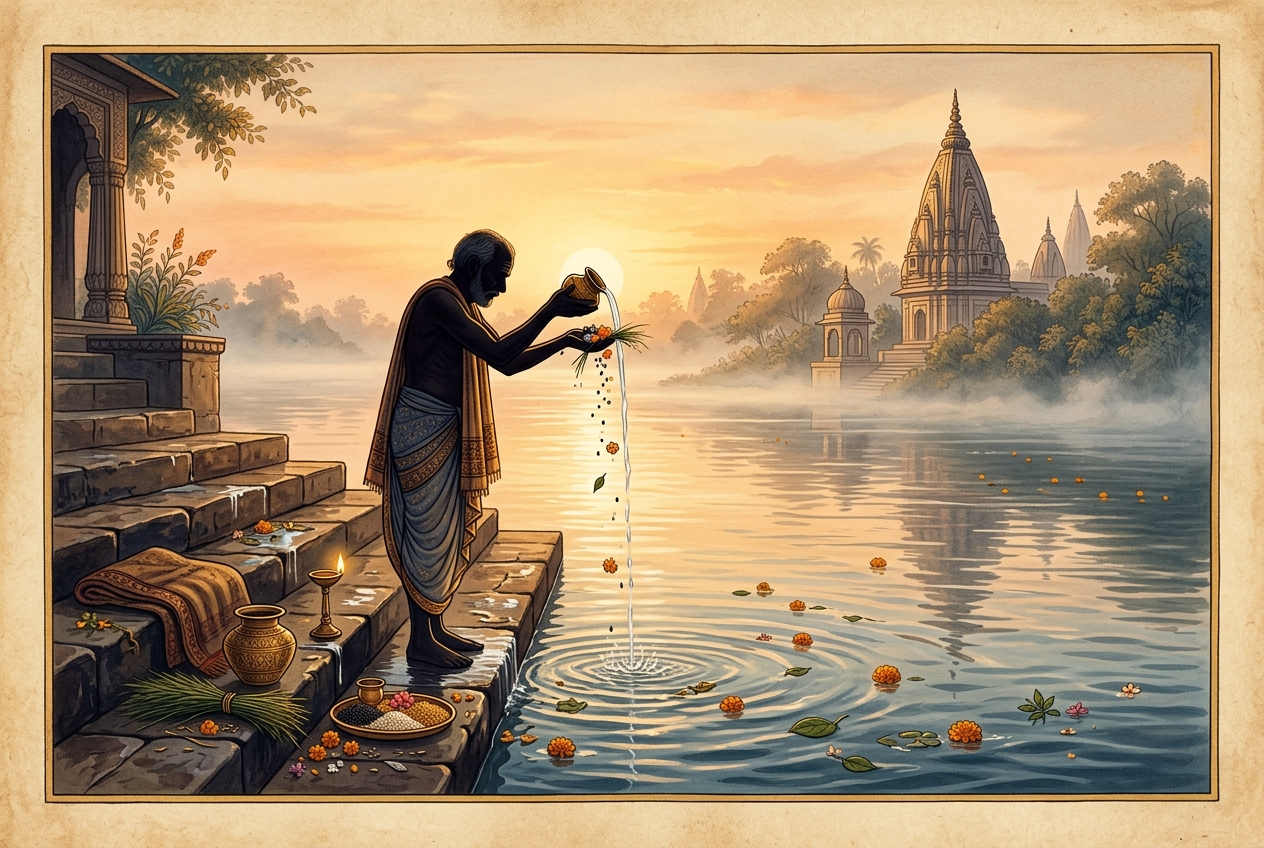
Pitṛ Pakṣa (पितृ पक्ष) is the sacred lunar fortnight dedicated to invoking, honouring, and feeding the Pitṛs—our ancestors. In modern public discourse, ancestral rites are too frequently reduced to fear-driven folklore, rigid superstition, or mechanical calendar obligations. Within the classical framework of Sanātana Dharma, however, the observance asks an essential philosophical question: What does it mean to receive life from those who came before us?
Human existence does not originate in an isolated individual. Long before our arrival, unbroken generations laboured, preserved knowledge, established languages, and sustained traditions. Through them, we inherit physical form, memory, culture, and civilization. We inherit not merely physical property, but an active place in a continuing lineage.
Pitṛ Pakṣa is the deliberate, conscious recognition of this sacred transmission.
Pitṛ Pakṣa 2026: The Sacred Calendar
The ancestral fortnight corresponds to the Krishna Pakṣa (waning phase) of the lunar month. Due to regional calendrical conventions, this period falls during the month of Āśvina in North Indian Pūrṇimānta reckonings, and during Bhādrapada in South and West Indian Amānta calendars. Despite differing month names, both systems align on the exact same lunar tithis.
Crucial Pañcāṅga Principle: A Śrāddha rite is governed strictly by the prevailing lunar tithi during the designated period of the day, not merely by the Gregorian solar date. Because astronomical sunrise, sunset, and tithi-sandhis vary by longitude and latitude, observance schedules must always be verified against an authentic local pañcāṅga for the city or tīrtha where the rites occur.
Textual & Philosophical Foundations
The veneration of ancestors did not originate as a medieval custom; it is rooted directly in the Vedic Saṁhitās.
Ṛgveda 10.15: The Hymn to the Pitṛs
The Pitṛ Sūkta of the Ṛgveda (10.15) explicitly addresses the collective communion between the living community and the departed ancestors:
इदं पितृभ्यो नमो अस्त्वद्य ये पूर्वासो य उपरास ईयुः । ये पार्थिवे रजस्या निषत्ताः ये वा नूनं सुवृजनासु विक्षु ॥
"Today let homage be paid to the Pitṛs—to those who went first, and to those who passed later; to those who dwell in terrestrial space, and to those residing among noble peoples." (Rig Veda 10.15.1)
The Vedic vision is profoundly compassionate: it honours not only the prominent and remembered, but also those whose personal names and markers have dissolved in time:
ये च इह पितरो ये च नेह यांश्च विद्म याँ उ च न प्रविद्म । त्वं वेत्थ यति ते जातवेदः स्वधाभिर् यज्ञं सुकृतं जुषस्व ॥
"Those ancestors who are here, and those who are not here; those whom we know and those whom we do not know—O Jātavedas (Agni), You know how many they are. Accept this well-ordered offering accompanied by Svadhā." (Rig Veda 10.15.13)
The Pañca Mahāyajñas & Pitṛ-ṛṇa
Classical Dharmaśāstras, such as the Manusmṛti, place the householder (gṛhastha) at the centre of cosmic reciprocity. A householder sustains the universe through five daily great duties (Pañca-mahāyajñas):
Brahma-yajña: Cultivating and transmitting sacred wisdom (svādhyāya).
Deva-yajña: Offerings to cosmic powers and divine forces (homa).
Pitṛ-yajña: Honouring ancestors through Tarpaṇa and Śrāddha.
Bhūta-yajña: Nourishing non-human beings, creatures, and the ecological realm (bali).
Manuṣya-yajña: Hospitality and service to guests and fellow humans (atithi-satkāra).
As stated in Manusmṛti 3.81:
ऋषीन् स्वाध्यायेनार्चयेत् देवान् यज्ञेन, पितृन् श्राद्धेन... (One should honour the Ṛṣis through regular study, the Devas through sacrifice, and the Pitṛs through Śrāddha).
In Indian thought, the human being is born with three fundamental debts (Trividha Ṛṇa): Deva-ṛṇa (to the cosmos), Ṛṣi-ṛṇa (to the teachers and seers), and Pitṛ-ṛṇa (to the lineage). Pitṛ-ṛṇa is not a punitive debt, but a structural acknowledgement that our existence, physical capabilities, and moral inheritance were gifted to us by our forebears. We balance this debt through filial care, respectful post-death rites, and by sustaining the continuity of life, virtues, and learning.
This Vedic spirit of reverence is encapsulated in the Taittirīya Upaniṣad (Śikṣāvallī 1.11):
मातृदेवो भव । पितृदेवो भव । आचार्यदेवो भव । अतिथिदेवो भव ॥ "Hold your mother as worthy of reverence; hold your father as worthy of reverence; hold your teacher as worthy of reverence; hold your guest as worthy of reverence."
Pitṛ Pakṣa extends this reverence across the threshold of death, transforming memory into ritual action.
Śrāddha & Tarpaṇa: Principles and Classifications
The word Śrāddha (श्राद्ध) is etymologically derived from Śraddhā (श्रद्धा)—an attitude of sincere faith, trust, and loving reverence. A Śrāddha is Śraddhayā dīyate yat tat śrāddham—that which is offered with genuine inner veneration.
Key Types of Śrāddha
Śrāddha is not a single, monolithic ceremony. Dharmaśāstra texts, particularly the Yājñavalkya Smṛti, delineate multiple categories based on context:
Ekoddiṣṭa Śrāddha: Rites focused on a single recently deceased person, performed without the invocation of the Viśvedevas.
Pārvaṇa Śrāddha: The classical rite performed on Amāvāsyā or during Pitṛ Pakṣa, directed simultaneously toward three ascending generations of paternal and maternal ancestors, accompanied by offerings to the Viśvedevas.
Sapīṇḍīkaraṇa: The critical transitional rite performed at the end of the mourning year that ritually unites the newly deceased (Preta) with the established community of the ancestors (Pitṛs).
Nāndī / Ābhyudayika Śrāddha: Joyous ancestral invocations performed prior to auspicious life-cycle events such as marriages, sacred thread ceremonies (Upanayana), or housewarmings.
Kāmya and Naimittika Śrāddha: Rites performed for specific spiritual fruits, or mandatory observances conducted on particular astronomical occasions (e.g., eclipses, saṅkrāntis).
The Distinction Between Preta and Pitṛ
Traditional Śāstras strictly distinguish between the Preta (the wandering spirit of the recently deceased undergoing transition) and the Pitṛ (the settled, ancestral state). The initial funeral rites (Antyeṣṭi) and subsequent daily offerings (Preta-kriyā) attend to the initial transitional stage. Through Sapīṇḍīkaraṇa, using the Vedic mantra ye samānāḥ, the deceased is formally admitted into the ancestral fold.
Confusing everyday Pitṛ Pakṣa rites with initial post-cremation funeral rites is a common error. Pitṛ Pakṣa operates primarily under the mature, benevolent framework of Pārvaṇa Śrāddha.
Ritual Anatomy of Pārvaṇa Śrāddha
A standard Pārvaṇa Śrāddha follows an ordered, intentional sequence preserved across Vedic Śākhās and Gṛhya-sūtras:
Śauca & Preparation Saṅkalpa Daiva-Āvāhana (Viśvedevas) Pitṛ-Āvāhana Arghya & Pūjā Piṇḍa Dāna Śrāddha Bhojana Tarpaṇa Dakṣiṇā & Dāna VisarjanaŚauca and Preparation: Physical cleanliness through bathing, wearing clean unstitched garments, and consecrating the ritual ground.
Saṅkalpa: Articulation of sacred intent, identifying geographical coordinates, solar and lunar dates, lineage (gotra), and ancestors being honoured.
Viśvedevas (The Divine Aspect): In Pārvaṇa Śrāddha, offerings are first made to the universal deities (Viśvedevas), who serve as guardians and witnesses of the ancestral rite.
Pitṛ-Āvāhana: Reverent invocation of three generations of paternal and maternal ancestors into prepared ritual seats represented by Kuśa grass.
Arghya and Upacāras: Respectful offerings of purified water, black sesame (tila), sacred grass (kuśa), and flowers.
Piṇḍa Dāna: Preparation and consecrated offering of rounded rice balls (mixed with sesame, barley, honey, and ghee) symbolizing ancestral embodiment. Where names are lost, ancient Gṛhya-sūtra formulas address them by their cosmic spheres (Earth, Atmosphere, Heaven).
Śrāddha Bhojana: Feeding invited Brāhmaṇas who ritualistically represent the ancestral and divine presence.
Tarpaṇa: Water libations accompanied by specific hand positions (Pitṛ-tīrtha) to satisfy the ancestors.
Dakṣiṇā and Dāna: Charitable giving of food, clothing, grains, and financial support according to capacity.
Visarjana and Svadhā: Concluding prayers, circumambulation, and respectful departure pronounced with the sacred syllable Svadhā—the Vedic utterance consecrated for ancestral offerings (in contrast to Svāhā used for the Devas).
Ritual Symbolism
Popular literature often invents speculative explanations for Śrāddha materials, claiming they absorb "negative electrical currents." The Dharmaśāstras view these items through sacred cosmology, not pseudoscience:
Tila (Black Sesame): One of the ancient sacred seeds prescribed across the Yājñavalkya Smṛti and Manusmṛti for ancestral rites, symbolizing sustenance and continuity.
Kuśa and Darbha Grass: Celebrated since the Vedic period for its structural purity, Kuśa forms the sacred mats (āsanas), purifying rings (pavitram), and consecrated surfaces upon which libations are offered.
Dakṣiṇa (Southern Direction): In traditional cosmology, the southern realm is governed by Yama, the lord of Dharma and guardian of the departed. Facing south during ancestral rites aligns the practitioner with the symbolic realm of the Pitṛs.
Svadhā (स्वधा): Just as Svāhā seals offerings to celestial devatās in the sacred fire, Svadhā is the specific Vedic benedictory utterance through which offerings are consecrated to the realm of the Pitṛs.
Feeding Animals and Birds: Bhūta-Yajña vs. Literalism
A widespread feature of Pitṛ Pakṣa is the offering of food to cows, dogs, and crows. The crow, in particular, is traditionally associated with Yama's messenger realm.
Dharmartha clarifies this distinction: While feeding animals is an admirable domestic custom embedded within the broader ethic of Bhūta-yajña (compassion for all living beings), it must not be converted into superstitious literalism. A crow consuming an offering is not physical proof of a deceased relative's direct physical presence; it is an act of sacred charity connecting our home with the wider ecological web.
The Daily Timing: Aparāhṇa, Kutupa, and Rauhiṇa
Unlike Deva-pūjā, which is typically conducted in the morning (Prātah-kāla), ancestral rites are prescribed for the afternoon (Aparāhṇa).
Classical Smṛtis divide the daylight into fifteen muhūrtas. The eighth muhūrta is known as Kutupa Muhūrta, followed shortly by Rauhiṇa Muhūrta. Yājñavalkya Smṛti (1.226) identifies these middle-to-late afternoon periods as optimal for initiating and completing Śrāddha rites. Because muhūrtas depend entirely on sunrise and sunset timings, exact hours vary significantly between cities, requiring reference to a regional pañcāṅga.
Pan-Indian Expressions of Pitṛ Pakṣa
While textual roots remain uniform, ritual customs vary across the subcontinent:
North India & Tīrtha Kṣetras: Strong emphasis is placed on pilgrimage-based Piṇḍa Dāna at sacred tīrthas such as Gayā (Phalgu river/Viṣṇupada temple), Kāśī, and Prayāgrāj.
Eastern India (Bengal, Assam, Odisha): Mahālaya Amāvāsyā is observed with massive dawn Tarpaṇa along the banks of the Gaṅgā and other sacred rivers. In Bengal, Mahālaya simultaneously concludes Pitṛ Pakṣa and welcomes the descent of Goddess Durgā, bridging ancestral remembrance with Navarātri.
Western India (Maharashtra & Gujarat): Distinctive domestic feasts are prepared for the Pitṛs. In Gujarat, Trayodaśī has special associations (Kākbali or Bālabholānī Teras) dedicated to departed children or specific ancestors.
South India (Tamil Nadu, Kerala, Karnataka, Andhra Pradesh): Known variously as Pitṛ Karma or Bali, coastal and riverbank libations (such as Vāvu Bali in Kerala) use boiled rice, sesame, and water offered on plantain leaves. The observances align with North Indian dates despite falling under the Amānta month name of Bhādrapada.
Nepal: Rites emphasize Pinda Dāna at venerated shrines such as Gokarṇa (Gokarṇa Aunsi) along the Bagmati river, carrying forward ancient indigenous temple traditions.
Common Misconceptions & Clarifications
Is Pitṛ Pakṣa "Inauspicious"? No. Pitṛ Pakṣa is a solemn, dedicated sacred period (śubha/pavitra for ancestral duties), not an evil or spiritually cursed time. While major celebrations like weddings or initial housewarmings are deferred so that attention remains focused on the Pitṛs, ordinary life, productive work, and worship continue normally.
Are Commercial Purchases Forbidden? No scriptural text bans purchasing everyday necessities, starting study, or conducting business during Pitṛ Pakṣa. Deferring major personal celebrations is a regional cultural preference, not a universal Dharmic injunction.
Can Maternal Ancestors Be Honoured? Yes. Dharmaśāstras explicitly prescribe offerings for both the paternal (pitṛ-varga) and maternal (mātṛ-varga) lineages. Mātṛ Navamī (4 October 2026) is specifically reserved in many traditions for mothers, grandmothers, and female ancestors.
What if the Exact Death Tithi or Name Is Unknown? The tradition provides a built-in resolution: Sarva Pitṛ Amāvāsyā (10 October 2026) is designed for collective remembrance of all ancestors whose death tithis, names, or circumstances are unknown.
Contemporary Practice: The Ethics of Continuity
For modern families separated by migration, urban life, and generational distance, ancestral memory is easily lost. Yet, this makes Pitṛ Pakṣa more relevant today than ever.
Alongside formal rites, families can embrace Pitṛ Pakṣa through living ancestral memory:
Preserve History: Gather family elders, record oral histories, identify ancestral towns and villages, and document old photographs.
Teach the Next Generation: Share stories of ancestral struggles and sacrifices with children, passing down their names and traditions.
Targeted Dāna: Channel charity into food distribution, education for underprivileged children, tree planting, or lineage-preserving institutions.
Pitṛ Pakṣa invites a psychological shift from consumption to offering, from individual entitlement to generational gratitude.
Every human being is temporarily a descendant, briefly a custodian of the present, and will eventually become an ancestor. The observance asks us to reflect not only on how we remember the past, but on what kind of ancestors we ourselves will be: What values, ecological balance, culture, and ethics will we pass forward?
Authentic Textual Sources
Ṛgveda Saṁhitā (Maṇḍala 10, Sūkta 15): The foundational Pitṛ Sūkta invoking the departed across cosmic realms.
Taittirīya Upaniṣad (Śikṣāvallī 1.11): Classical ethical injunctions on filial and spiritual reverence (mātṛdevo bhava, pitṛdevo bhava).
Manusmṛti (Adhyāya 3): Detailed exposition of the Pañca-mahāyajñas, Pitṛ-yajña, rules of hospitality, and ancestral offerings.
Yājñavalkya Smṛti (Ācārādhyāya, Śrāddha Prakaraṇa, verses 217–270): Classification of Śrāddha, muhūrta determinations (Aparāhṇa/Kutupa), Sapīṇḍīkaraṇa, and maternal ancestral rites.
Āśvalāyana & Pāraskara Gṛhya-sūtras: Classical domestic rituals, Piṇḍa preparation, and adaptations for unknown ancestors.