Deity
काली
Kali
The Primordial Dynamic Absolute, Devourer of Time, Slayer of Chanda and Munda
काली
परिचय
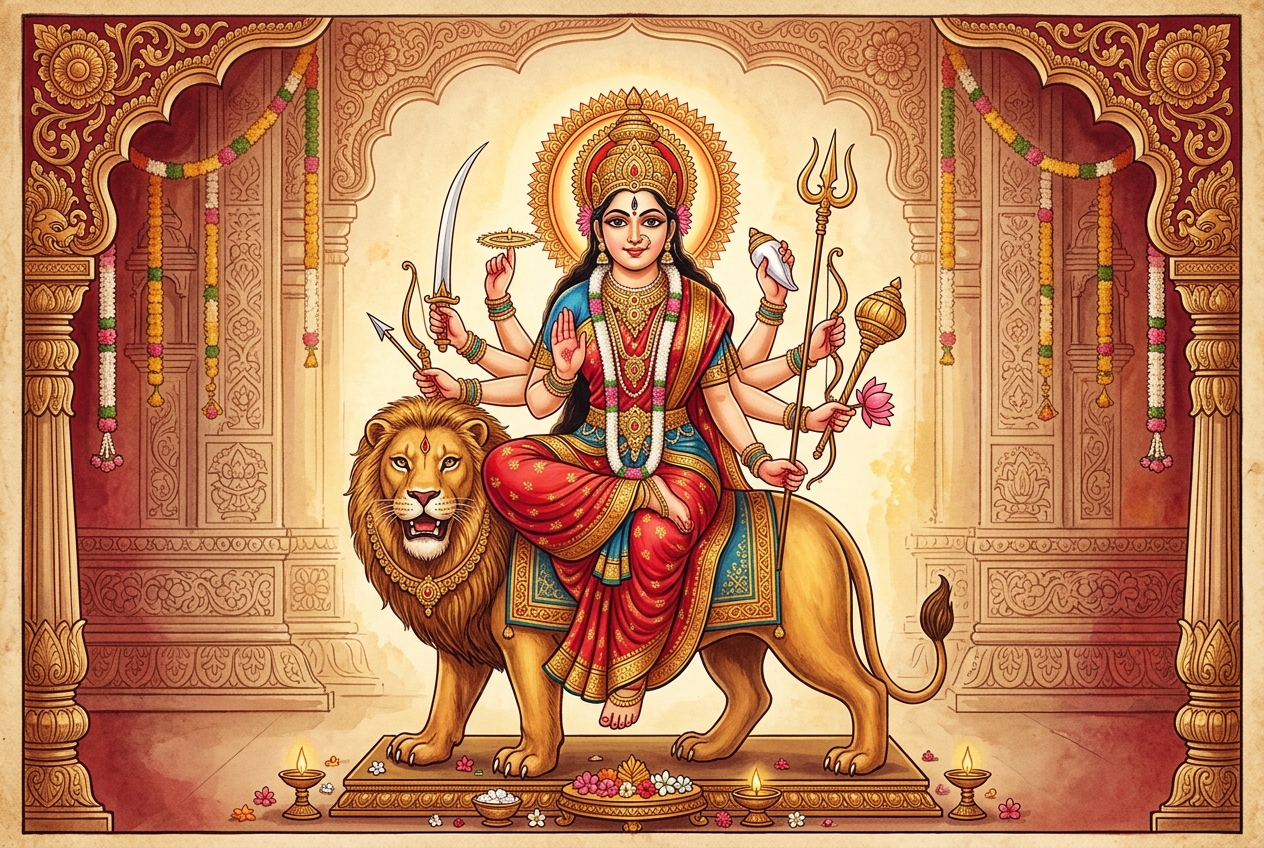
AboutGoddess Kali (Kālī) first emerges into the canonical record within the Mundaka Upanishad 1.2.4, where She is invoked as the darkest, most penetrating of the seven flickering tongues of Agni that consume sacrificial oblations. Her full metaphysical and martial manifestation crystallises in the Devi Mahatmya of the Markandeya Purana, Chapter 7. There, She erupts from the contracted, wrath-blackened forehead of the Great Goddess Ambika to confront the cosmic forces of degeneration led by Chanda and Munda, an act of decapitation that earns Her the epithet Chamunda. In authentic Shakta and Kaula treatises, Her iconography is an exact cartography of non-dual metaphysics: She is visualised as pitch-black or deep azure (Nīla-varṇa), embodying unconditioned, boundless space. She is Digambari—unclothed, clad only in the quarters of the sky—because no conceptual garment of Maya can encompass Her. Her hair is completely unbraided and dishevelled (Muktakeśī), representing absolute liberation from conventional restraints. Around Her neck hangs a garland of fifty severed human heads (Muṇḍamālā), corresponding to the fifty seed-letters of the Sanskrit alphabet (Varṇamālā) that govern cosmic manifestation, while Her skirt is composed of severed human arms, denoting the surrender of all accumulated karmas. In Her left hands She wields the raised cleaver (Khaḍga) of discerning intellect and holds a severed head; Her right hands bestow the gestures of fearlessness (Abhaya) and boon-granting (Varada). She stands upon the supine, motionless body of Lord Shiva.
Significance
In non-dual Shakta theology (Śāktādvaita) and classical Tantric systems, particularly across texts such as the Mahanirvana Tantra and the Karpuradi-stotra, Kali is established as Adya Shakti—the primordial kinetic pulse of the Absolute prior to the advent of space, light, and causation. Where Shiva represents the immutable, transcendent ground of pure unconditioned awareness, Kali is the self-reflective, dynamic surge through which that awareness experiences and dissolves the universe. Her placement upon Shiva’s chest illuminates the foundational Tantric axiom: pure consciousness bereft of dynamic power is inert—"Shiva without Shakti is a corpse" (Śivaḥ Śaktihīnaḥ Śavaḥ). As the feminine embodiment of Kala, She is the devourer of time itself; when the cosmic cycle culminates in the great dissolution (Mahāpralaya), the entirety of differentiated creation contracts back into Her unmanifest void. For the advanced initiate, Her presence in the cremation grounds is not macabre horror, but radical soteriology: She is the ruthless grace that severs the root of egoic identity (Ahaṃkāra), reducing worldly attachment to ash and revealing the immutable Self beyond birth, transience, and death.
Associated content is being added.
Your notes
Private reflections you can revisit anytime.
Questions & Discussions
Ask a question or start a discussion about this page.
- No questions or discussions yet — be the first.