A note on Dharmartha's ongoing development:Dharmartha is currently in an active phase of content development. Our articles, references, descriptions, and other materials are being reviewed, expanded, and updated r…
Ancestral fortnight · 2026
Pitru Paksha
पितृ पक्ष २०२६
स्मरणम् · श्रद्धा · तर्पणम् · दानम् · धर्मः
The sacred fortnight of remembering and honouring the ancestors — through Shraddha, Tarpana, Pinda Dana and Dana. A time that asks: what does it mean to receive life from those who came before us?
This year's fortnight has concluded — bookmark this guide for future observances.
Fortnight begins
Sun, 27 September 2026
Krishna Pratipada
Purnima Shraddha
Sat, 26 September 2026
Precedes the main sequence
Sarva Pitr Amavasya
Sat, 10 October 2026
Mahalaya Amavasya
Understanding
What is Pitru Paksha?
Pitru Paksha literally means the fortnight of the Pitrs. In the Hindu understanding, life does not begin with the individual — before us were parents, grandparents and generations whose names may now be forgotten. We inherit not property alone, but a place in a continuing story.
The word Pitr is connected with father and ancestor, but in ritual literature it refers to a far wider category — known and unknown, paternal and maternal. During this fortnight, the living consciously turn toward those from whom they received life.
Remember those from whom you received life.
Pitr-rna — the debt to the ancestors — is not financial. We are recipients before we are creators: language, tradition, knowledge and culture came to us through people we never met. This idea asks not for guilt, but for responsibility.
Who are the Pitrs?
The Pitrs are not simply 'dead relatives'. The tradition holds a developed conception of ancestral beings — the familiar three-generation framework, and beyond it the known and unknown, paternal and maternal ancestors.
पिता
Pita
Father
पितामह
Pitamaha
Grandfather
प्रपितामह
Prapitamaha
Great-grandfather
Known & unknown
The Grhya-sutras preserve procedures for when ancestral names are unknown. Remembrance does not depend on perfect genealogy — forgetfulness of a name does not require abandonment of remembrance.
Preta & Pitr
The newly deceased is called 'Preta'; after Sapindikarana a ritual relationship is established with the ancestral group. Antyeshti → Preta-kriya → Ekoddishta → Sapindikarana → annual Shraddha are not interchangeable ceremonies.
The householder's Five Great Yajnas
The Pitrs are not an isolated concern — they belong to a larger vision of reciprocity between human beings and the worlds from which we receive.
Brahma Yajna
Svadhyaya — offering to sacred knowledge
Deva Yajna
Offering to the Devas through yajna
Pitr Yajna
Offering to the Pitrs through Tarpana & Shraddha
Bhuta Yajna
Offering to all beings
Atithi Yajna
Hospitality and offering to human guests
Shraddha Calendar 2026
New Delhi panchangaShraddha is determined by the tithi, not by the Gregorian date alone. Exact tithi boundaries and muhurtas are location-specific — always check the panchanga for your place.
Bhadrapada Purnima Shraddha
Shraddha of the Purnima tithi — one day before Pitru Paksha (not counted within it).
Pratipada Shraddha
Beginning of Pitru Paksha.
Dwitiya Shraddha
For ancestors who departed on the Dwitiya tithi.
Tritiya Shraddha · Maha Bharani
Bharani Nakshatra is linked to Yama; Maha Bharani is a special ancestral observance.
Chaturthi Shraddha
For ancestors who departed on the Chaturthi tithi.
Panchami Shraddha
This year Chaturthi and Panchami Shraddha fall on the same civil day.
Shashthi Shraddha
For ancestors who departed on the Shashthi tithi.
Saptami Shraddha
For ancestors who departed on the Saptami tithi.
Ashtami Shraddha
For ancestors who departed on the Ashtami tithi.
Navami · Matru Navami
The tithi for remembering mothers and female ancestors.
Dashami Shraddha
For ancestors who departed on the Dashami tithi.
Ekadashi Shraddha
For ancestors who departed on the Ekadashi tithi.
Dwadashi · Magha Shraddha
The Magha Nakshatra observance; the Shraddha for sannyasis also falls here.
Trayodashi Shraddha
For ancestors who departed on the Trayodashi tithi.
Chaturdashi Shraddha
For ancestors who died by weapon, accident or an untimely death.
Sarva Pitru Amavasya
Mahalaya Amavasya — the day for all ancestors, even when the death-tithi is unknown.
Dates follow the Dharmartha Jyotish Engine 2026 reckoning. This year Chaturthi and Panchami Shraddha share 30 September; the Bhadrapada Purnima Shraddha precedes Pitru Paksha.
The Practices of the Fortnight
Shraddha
Reverence given ritual form — the Parvana Shraddha on the ancestor's tithi.
Tarpana
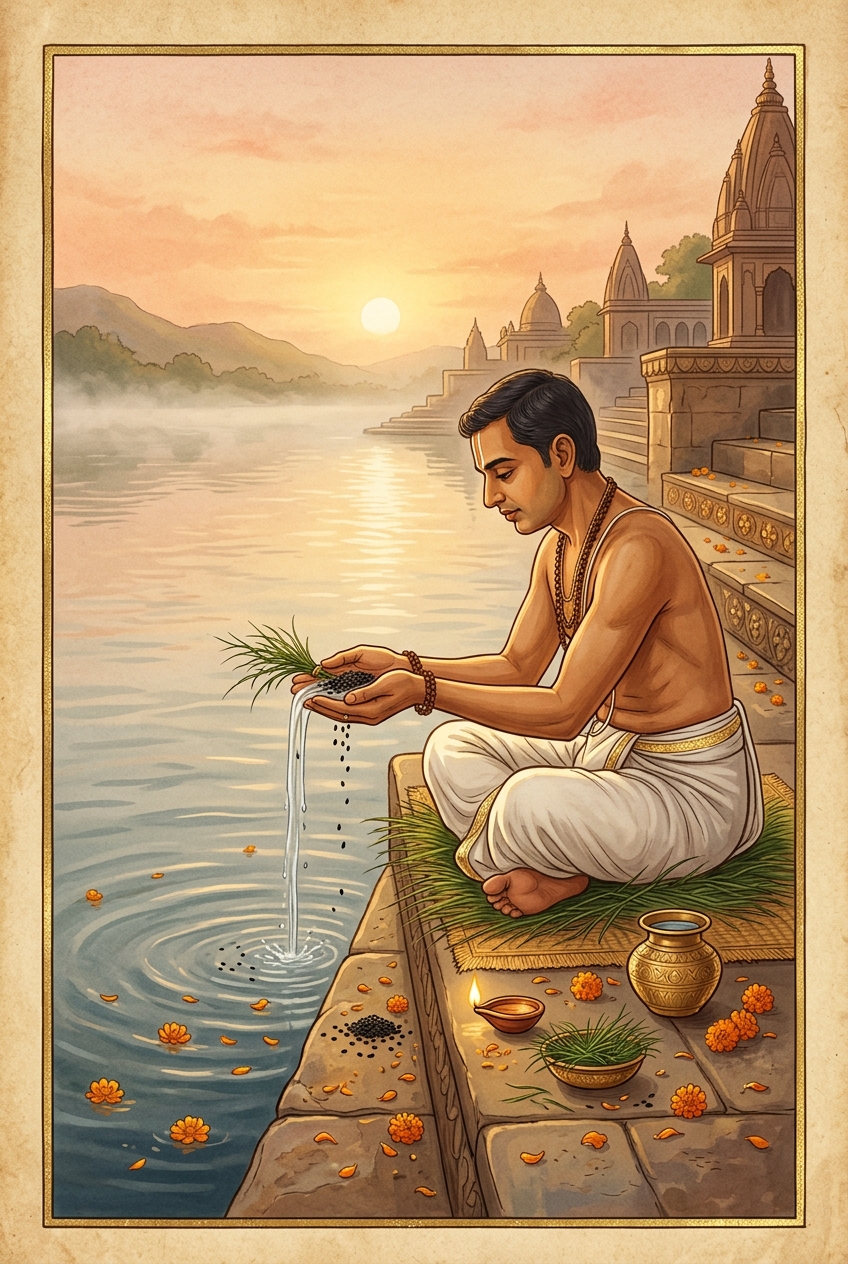
Offering water with sesame to the ancestors, with the prescribed mantras.
Pinda Dana
The reverent offering of pindas prepared from rice and prescribed ingredients.
Dana
Food, clothing, dakshina and service — turning gratitude into action.
Smarana
Preserving and passing forward the names, stories and traditions of ancestors.
Restraint
Many families observe a sattvic, restrained way of life through the fortnight.
Sacred Substances & Symbols
The substances used in Shraddha belong to the larger structure of the rite — understood not through modern 'energy' explanations, but as scriptural offerings.
Tila (Sesame)
Black sesame is a prescribed traditional substance in Pitr rites — mentioned in the Yajnavalkya and Manu Smritis. Not a 'negativity absorber' — a scriptural offering.
Kusha / Darbha
Kusha grass is used for ritual seats, placement of offerings and Tarpana across Vedic ritual.
Svadha
'Svaha' for the Devas, 'Svadha' for the Pitrs — the distinct ritual word of ancestral offering; Manusmriti calls it the highest benediction.
The South
The southern direction is associated with Yama and the Pitrs; Shraddha prescribes a southward orientation — this is ritual cosmology.
Special Days of the Fortnight
29 Sep
Maha Bharani
Bharani Nakshatra is associated with Yama; Maha Bharani in the Pitru period is a special observance in several traditions.
4 Oct
Matru Navami
Navami is associated with remembrance of mothers and female ancestors. The observance varies by region and family.
10 Oct
Sarva Pitr Amavasya
The concluding day — most important for collective remembrance, and used even when the exact death-tithi is unknown.
The Shraddha time
Kutup, Rauhina & Aparahna
Pitru Paksha Shraddha is traditionally associated with the Aparahna portion of the day. Within it, the Kutup and Rauhina muhurtas are important. The exact clock time depends on latitude, longitude, sunrise, sunset and date.
Kutup Muhurta
≈ 11:47 – 12:35
Rauhina Muhurta
≈ 12:35 – 13:22
Aparahna Kala
≈ 13:22 – 15:45
This is the Delhi 2026 Panchami calculation as an example. Never rely on a single India-wide Shraddha time — check the muhurta for your own location.
Open the Panchangam for your locationTypes of Shraddha
DharmashastraThe Dharmashastra (Manu, Yajnavalkya, Nirnaya Sindhu) describes several kinds of Shraddha. The Pitru Paksha rite belongs chiefly to the 'Parvana' category.
Nitya
The daily or regular offering to the ancestors.
Naimittika (Ekoddishta)
Occasional Shraddha directed to one departed individual.
Parvana
Performed on parva days for three ancestral generations — the form of Pitru Paksha.
Sapindana
The rite that unites the newly-deceased (preta) with the ancestral Pitrs.
Vriddhi (Nandimukha)
An auspicious Shraddha on happy occasions such as births and marriages.
Tirtha
Shraddha performed at sacred places such as Gaya.
Shraddha Vidhi
Parvana Shraddha — an overviewA structured overview of Parvana Shraddha — not a substitute for the ritual manual of a specific shakha or family. A formal Shraddha should be performed according to your tradition.
- 01
Shaucha & Preparation
Bathing, clean clothing, purifying the place, and preparing kusha, vessels, tila, water and food.
- 02
Sankalpa
Stating the intention with place, tithi, gotra, the ancestor's name and relationship.
- 03
Vishvedevas
The Daiva component of Parvana Shraddha — invoking the Vishvedevas.
- 04
Avahana
Respectfully welcoming the invited participants who represent the Fathers.
- 05
Arghya
Offering water, tila, kusha, fragrance and other prescribed substances.
- 06
Pitr Avahana
Invoking the ancestors by name, gotra and relationship; alternative formulas when names are unknown.
- 07
Pinda Dana
Offering pindas for father, grandfather and great-grandfather with the prescribed mantra and orientation.
- 08
Tarpana
Offering water with tila and the prescribed mantras.
- 09
Shraddha Bhojana
Feeding the invited with purity, hospitality and restraint.
- 10
Dakshina
Dakshina offered respectfully, according to tradition and one's means.
- 11
Dana
Charitable giving that extends the meaning of the rite.
- 12
Conclusion & Svadha
Blessings, prayer and a respectful dismissal — concluding with Svadha.
A simplified home Tarpana
For those whose tradition permits home Tarpana, the conceptual sequence. This is not a universal Vedic Tarpana Vidhi — the exact mantras and procedure must follow your tradition.
- 1.Snana— Bath and purification.
- 2.Asana— Sit in a clean place.
- 3.Sankalpa— State whom the Tarpana is for.
- 4.Kusha— Use darbha/kusha if prescribed.
- 5.Tila— Water with black sesame, if prescribed.
- 6.Pitr Smarana— Remember the ancestors.
- 7.Tarpana— Offer water with the appropriate mantra and hand position.
- 8.Prarthana— Pray for the peace of the departed and the family.
- 9.Dana / Seva— Perform an act of giving where appropriate.
What to do in the fortnight
Perform Shraddha
On the ancestor's death-tithi.
Perform Tarpana
According to your tradition.
Give Dana
Food, clothing, dakshina — as you can.
Remember
Preserve the names and stories of ancestors.
Serve
Let remembrance become an act of seva.
Practise restraint
A sattvic, restrained way of life.
Mantras & Verses
3 recitalsइदं पितृभ्यो नमो अस्त्वद्य ये पूर्वासो य उपरास ईयुः ।
idaṁ pitṛbhyo namo astv adya | ye pūrvāso ya uparāsa īyuḥ
Today let there be homage to the Fathers — to those who went before and those who passed on.
ये च इह पितरो ये च नेह यांश्च विद्म याँ उ च न प्रविद्म ।
ye ceha pitaro ye ca neha | yāṁś ca vidma yāṁ u ca na pravidma
Those ancestors who are here and those who are not — those whom we know, and those whom we do not.
मातृदेवो भव । पितृदेवो भव । आचार्यदेवो भव । अतिथिदेवो भव ॥
mātṛdevo bhava | pitṛdevo bhava | ācāryadevo bhava | atithidevo bhava
Regard your mother, father, teacher and guest as worthy of reverence.
Insight
What Shraddha teaches
Ritual turns memory into action. We cannot physically feed those who have died, but we can prepare food in their remembrance. We cannot repay the past, but we can give in gratitude.
Forgetfulness → Smriti
We remember rather than forget.
Consumption → Offering
We give rather than merely take.
Inheritance → Responsibility
What we received must be handled with care.
Fear → Reverence
We approach the ancestors with reverence, not fear.
Pitru Paksha looks backward, but its deepest implication points forward — what kind of ancestor will I become?
Regional Traditions
North India
In UP, Bihar, Rajasthan and Haryana, Pinda Dana is prominent; Gaya, Kashi and Prayaga are important ancestral tirthas.
Maharashtra & Gujarat
Distinctive Mahalaya customs; in Gujarat, Trayodashi is known by names such as Kakbali / Balabholani Teras.
Bengal
Mahalaya Amavasya carries deep cultural significance; Tarpana at water bodies and the turn toward the Durga Puja season.
South India
Regional Pitr Karma forms across the South; the Amanta calendar means the lunar-month name differs, though the tithis align.
Odisha & Assam
Distinctive regional Tarpana and Shraddha forms involving rice, sesame and water.
Nepal
Its own Shraddha and Pinda Dana traditions, including observances at sacred places such as Gokarna.
Pitr-karmas differ across shakha, sampradaya and family tradition. For a formal Shraddha, follow your family tradition or seek guidance from a qualified Acharya/Purohita.
Tirtha Shraddha — Sacred Places
Though Shraddha may be performed at home, certain tirthas are especially glorified for ancestral rites and Pinda Dana.
Gaya, Bihar
The Vishnupad kshetra — the foremost tirtha for Pinda Dana; Gaya Shraddha is especially glorified.
Kashi (Varanasi)
Tarpana on the Ganga banks; the Pishach Mochan kund is linked with ancestral rites.
Prayagraj
Bathing, Tarpana and Shraddha at the Triveni Sangam.
Brahmakapal, Badrinath
A highly sacred Himalayan site for Pinda Dana.
Trimbakeshwar, Nashik
On the Godavari; renowned for Narayan Nagbali and ancestral rites.
Siddhpur, Gujarat
Bindu Sarovar — the special tirtha for Matru Shraddha (rites for the mother).
Customs — reverence, not fear
Pitru Paksha is sometimes presented through fear. The classical framework is far richer — shraddha, smriti, gratitude, dana and dharma. A few customs, seen with balance.
Feeding crows
A widespread tradition. 'If a crow eats, the ancestor has come' — treat this as traditional belief, not empirical fact; honour the symbol without literalism.
Feeding animals
Feeding cows, dogs and other beings fits within the wider framework of Bhuta-yajna and hospitality.
Food
There is no single universal list. Many families keep a sattvic, restrained diet — follow your family tradition or your Acharya's guidance.
Is it inauspicious?
It is a sacred, ancestor-dedicated period. There is a difference between postponing major celebrations and believing 'everything is harmful'.
Pitru Dosha
Pitru Dosha — resolution, not fear
In the Jyotisha and Dharmashastra traditions, 'Pitru Dosha' refers to the effect of neglected duties toward the ancestors, or incomplete ancestral rites within a lineage. It is often associated with the Sun, Rahu and the ninth house in the birth chart.
Yet the classical view does not treat it as a matter of fear or superstition. Its essential remedy is precisely what Pitru Paksha teaches — sincere Shraddha, Tarpana, Dana and seva; remembrance of the ancestors and upright conduct.
The true resolution of Pitru Dosha is not ritual fear, but gratitude, remembrance and dharmic conduct.
Before any dosha-nivarana ritual, seek guidance from a qualified Acharya/Purohita. Be wary of fear-based, commercial 'instant remedy' claims.
Living remembrance
A family practice
Alongside the formal Shraddha, this fortnight is a chance to make remembrance a living culture. Modern families lose ancestral memory through migration and the passing of generations — this fortnight can restore some of that continuity.
- Remember one ancestor — speak their name.
- Tell a child one story about them.
- Preserve one thing — a photo, letter, recipe or prayer.
- Give something — food, dana, time or service.
- Identify the ancestral village and family names.
- Make one resolve — which quality will you carry forward?
Frequently asked
Common questions
Sources & Textual Foundations
Rigveda 10.15 — Pitr Sukta
A principal Vedic hymn to the Pitrs; invokes known and unknown ancestors and Svadha.
Taittiriya Upanishad 1.11
Matrudevo bhava · Pitrudevo bhava — reverence toward mother, father, teacher and guest.
Manusmriti — Chapter 3
Extensive material on the Pancha-mahayajnas, Pitr-yajna, Tarpana, Shraddha, pinda, kusha, tila and Svadha.
Yajnavalkya Smriti — Shraddha Prakarana
Shraddha classification, timing, the Parvana procedure, maternal ancestors and Sapindikarana.
Grhya Sutra Tradition
Early domestic procedures for Shraddha and pinda, including formulas for unknown ancestors.
Puranic & Later Tradition
Later Shraddha literature including the Garuda, Matsya Puranas and Vishnu Smriti.
Editorial note: Pitr-karmas are practised in different forms across India's regions, shakhas, sampradayas and family traditions. Mantras, sequence, materials and eligibility can differ. Dharmartha presents the textual foundations and major traditional forms — for a formal Shraddha, follow your family tradition or a qualified Acharya/Purohita.
ये च इह पितरो ये च नेह
यांश्च विद्म याँ उ च न प्रविद्म ॥
The ancestors whom we know and those whom we do not — every generation stands upon the work of those before it. Pitru Paksha gives us a time to bow to that continuity. Remember · Offer · Give · and become a worthy ancestor yourself.