Sukta
Mantra Pushpam
श्री मन्त्रपुष्पम्
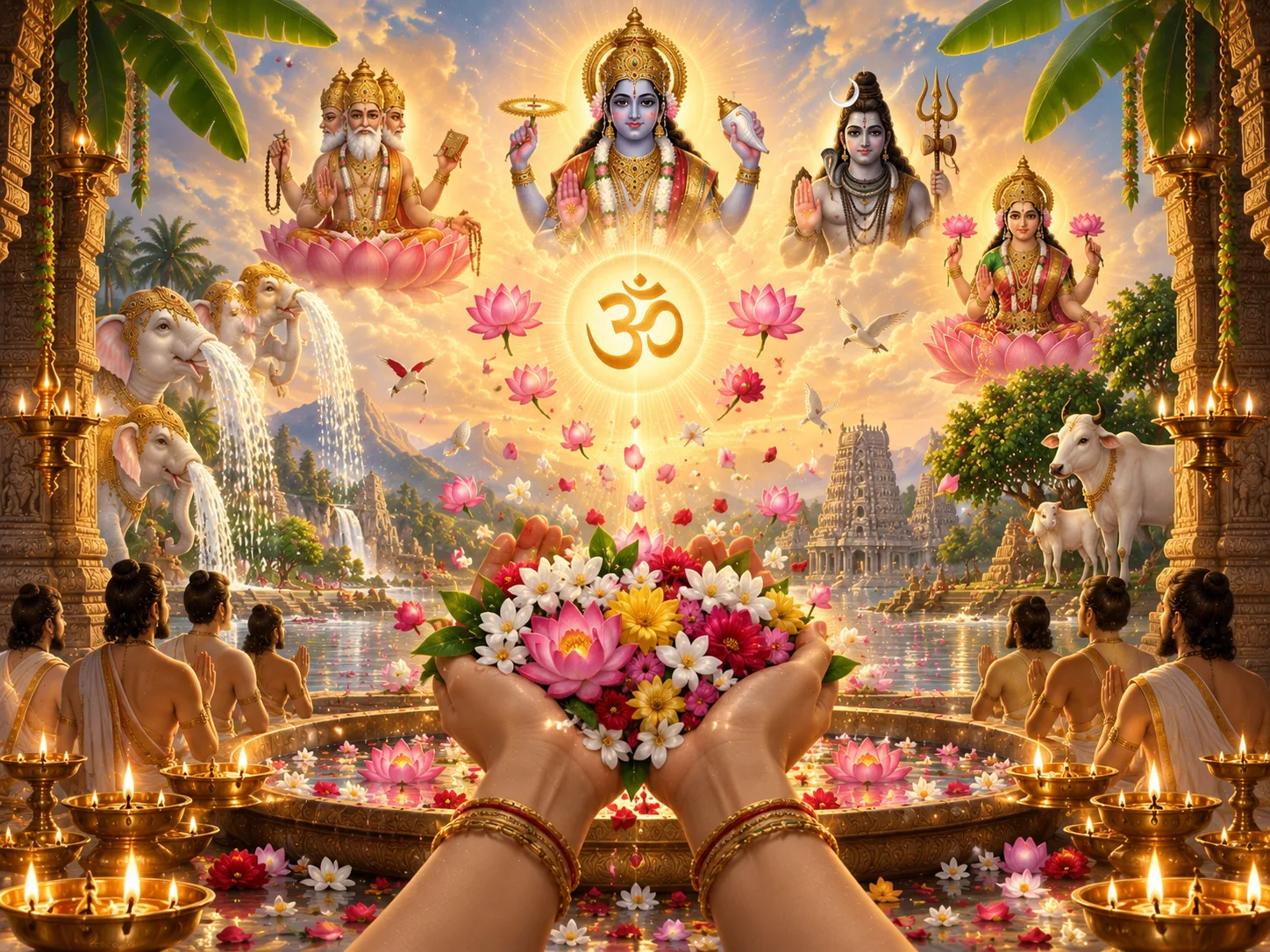
Mantra Puṣpam (literally "The Flower of Mantras") is situated within the first Prapāṭhaka (the 22nd Anuvāka, part of the Aruṇa Ketuka Cayana / Sūryanamaskāra Praśna) of the Taittirīya Āraṇyaka of the Krishna Yajurveda. In traditional temple and domestic liturgies, it constitutes the ceremonial grand finale of Ṣoḍaśopacāra Pūjā, chanted while devotees and priests hold fresh blossoms and unbroken sanctified rice (akṣata) in cupped palms before offering them at the deity's lotus feet. Cosmologically, the text unfolds an intricate vision of environmental and metaphysical interdependence: water (Āpaḥ) is celebrated as the primordial flower (puṣpam) and universal foundation (āyatanam) of all cosmic phenomena—fire, wind, solar brilliance, lunar cool, starry spheres, monsoon clouds, and the seasonal progression of cosmic time. Seamlessly conjoined with the ancient Vedic Sāmrājya coronation prayers and the Kuberavaiśravaṇa mantra, the hymn anchors human life in cosmic order, peace, and uninterrupted abundance.
- Deity
- Āpaḥ (The Primordial Waters / Universal Life-Force / Prāṇa), Agni, Vāyu, Sūrya, Candramā, Nakṣatrāṇi, Parjanya, Saṁvatsara, Paramātman / Sadāśiva, the Cosmic Sovereignty (Samrāṭ-Virāṭ), and Rājādhirāja Kubera Vaiśravaṇa
- Tradition
- Krishna Yajurveda (Taittirīya Āraṇyaka 1.22) / Smārta, Śrī Vaiṣṇava, and Śaiva Agamic Traditions / Pan-Vedic
- Purpose
- Mandatory Vedic hymn for offering consecrated flowers (Puṣpāñjali) at the conclusion of Ṣoḍaśopacāra Pūjā, temple Abhiṣeka, and Mahārati. Attaining unshakable psychological grounding, a stable dwelling, and cosmic support in life (Āyatanavān bhavati). Bestowing blossoming vitality, noble progeny, thriving agriculture, and abundant resources (Puṣpavān prajāvān paśumān bhavati). Invoking universal peace, sovereign stability (Sāmrājya-siddhi), and inexhaustible financial abundance through Kubera.
- Source
- Krishna Yajurveda (Taittirīya Āraṇyaka, Prapāṭhaka 1, Anuvāka 22; Aruṇa Ketuka Cayana), Rigveda Samhita (Mandala 8), Aitareya Brahmana (Coronation Mantras 8.12–15), Taittiriya Samhita
मूल पाठ
Sanskrit textप्रारम्भीय मन्त्रः ॐ यो॒ऽपां पुष्पं॒ वेद॑ । पु॑ष्पवान् प्र॒जावा᳚न् पशु॒मान् भ॑वति । च॒न्द्रमा॒ वा अ॒पां पुष्पम्᳚ । पु॑ष्पवान् प्र॒जावा᳚न् पशु॒मान् भ॑वति । य ए॒वं वेद॑ ॥ मूल सूक्त-मन्त्राः यो॒ऽपामा॒यत॑नं॒ वेद॑ । आ॒यत॑नवान् भवति । अ॒ग्निर्वा अ॒पामा॒यत॑नम् । आ॒यत॑नवान् भवति । यो᳚ऽग्नेरा॒यत॑नं॒ वेद॑ । आ॒यत॑नवान् भवति । आपो॒ वा अ॒ग्नेरा॒यत॑नम् । आ॒यत॑नवान् भवति । य ए॒वं वेद॑
Prārambhīya Mantraḥ Oṁ yo'pāṁ puṣpaṁ veda | puṣpavān prajāvān paśumān bhavati | candramā vā apāṁ puṣpam | puṣpavān prajāvān paśumān bhavati | ya evaṁ veda || Mūla Sūkta-Mantrāḥ (Mantras 1–8) yo'pāmāyatanaṁ veda | āyatanavān bhavati | agnirvā apāmāyatanam | āyatanavān bhavati | yo'gnerāyatanaṁ veda | āyatanavān bhavati | āpo vā agnerāyatanam | āyatanavān bhavati | ya evaṁ veda
॥ १ ॥
यो॒ऽपामा॒यत॑नं॒ वेद॑ । आ॒यत॑नवान् भवति । वा॒युर्वा अ॒पामा॒यत॑नम् । आ॒यत॑नवान् भवति । यो वा॒योरा॒यत॑नं॒ वेद॑ । आ॒यत॑नवान् भवति । आपो॒ वै वा॒योरा॒यत॑नम् । आ॒यत॑नवान् भवति । य ए॒वं वेद॑
yo'pāmāyatanaṁ veda | āyatanavān bhavati | vāyurvā apāmāyatanam | āyatanavān bhavati | yo vāyorāyatanaṁ veda | āyatanavān bhavati | āpo vai vāyorāyatanam | āyatanavān bhavati | ya evaṁ veda
॥ २ ॥
यो॒ऽपामा॒यत॑नं॒ वेद॑ । आ॒यत॑नवान् भवति । अ॒सौ वै तप॑न्न॒पामा॒यत॑नम् । आ॒यत॑नवान् भवति । यो॒ऽमुष्य॒ तप॑त आ॒यत॑नं॒ वेद॑ । आ॒यत॑नवान् भवति । आपो॒ वा अ॒मुष्य॒ तप॑त आ॒यत॑नम् । आ॒यत॑नवान् भवति । य ए॒वं वेद॑
yo'pāmāyatanaṁ veda | āyatanavān bhavati | asau vai tapannapāmāyatanam | āyatanavān bhavati | yo'muṣya tapata āyatanaṁ veda | āyatanavān bhavati | āpo vā amuṣya tapata āyatanam | āyatanavān bhavati | ya evaṁ veda
॥ ३ ॥
यो॒ऽपामा॒यत॑नं॒ वेद॑ । आ॒यत॑नवान् भवति । च॒न्द्रमा॒ वा अ॒पामा॒यत॑नम् । आ॒यत॑नवान् भवति । यश्च॒न्द्रम॑स आ॒यत॑नं॒ वेद॑ । आ॒यत॑नवान् भवति । आपो॒ वै च॒न्द्रम॑स आ॒यत॑नम् । आ॒यत॑नवान् भवति । य ए॒वं वेद॑
yo'pāmāyatanaṁ veda | āyatanavān bhavati | candramā vā apāmāyatanam | āyatanavān bhavati | yaścandramasa āyatanaṁ veda | āyatanavān bhavati | āpo vai candramasa āyatanam | āyatanavān bhavati | ya evaṁ veda
॥ ४ ॥
यो॒ऽपामा॒यत॑नं॒ वेद॑ । आ॒यत॑नवान् भवति । नक्ष॑त्राणि॒ वा अ॒पामा॒यत॑नम् । आ॒यत॑नवान् भवति । यो नक्ष॑त्राणामा॒यत॑नं॒ वेद॑ । आ॒यत॑नवान् भवति । आपो॒ वै नक्ष॑त्राणामा॒यत॑नम् । आ॒यत॑नवान् भवति । य ए॒वं वेद॑
yo'pāmāyatanaṁ veda | āyatanavān bhavati | nakṣatrāṇi vā apāmāyatanam | āyatanavān bhavati | yo nakṣatrāṇāmāyatanaṁ veda | āyatanavān bhavati | āpo vai nakṣatrāṇāmāyatanaṁ veda | āyatanavān bhavati | ya evaṁ veda
॥ ५ ॥
यो॒ऽपामा॒यत॑नं॒ वेद॑ । आ॒यत॑नवान् भवति । प॒र्जन्यो॒ वा अ॒पामा॒यत॑नम् । आ॒यत॑नवान् भवति । यः प॒र्जन्य॑स्या॒यत॑नं॒ वेद॑ । आ॒यत॑नवान् भवति । आपो॒ वै प॒र्जन्य॑स्या॒यत॑नम् । आ॒यत॑नवान् भवति । य ए॒वं वेद॑
yo'pāmāyatanaṁ veda | āyatanavān bhavati | parjanyo vā apāmāyatanam | āyatanavān bhavati | yaḥ parjanyasyāyatanaṁ veda | āyatanavān bhavati | āpo vai parjanyasyāyatanam | āyatanavān bhavati | ya evaṁ veda
॥ ६ ॥
यो॒ऽपामा॒यत॑नं॒ वेद॑ । आ॒यत॑नवान् भवति । संवत्स॒रो वा अ॒पामा॒यत॑नम् । आ॒यत॑नवान् भवति । यः सं॑वत्स॒रस्या॒यत॑नं॒ वेद॑ । आ॒यत॑नवान् भवति । आपो॒ वै सं॑वत्स॒रस्या॒यत॑नम् । आ॒यत॑नवान् भवति । य ए॒वं वेद॑
yo'pāmāyatanaṁ veda | āyatanavān bhavati | saṁvatsaro vā apāmāyatanam | āyatanavān bhavati | yaḥ saṁvatsarasyāyatanaṁ veda | āyatanavān bhavati | āpo vai saṁvatsarasyāyatanam | āyatanavān bhavati | ya evaṁ veda
॥ ७ ॥
यो॒ऽप्सु नावं॒ प्रति॑ष्ठितां॒ वेद॑ । प्रत्ये॒व ति॑ष्ठति
yo'psu nāvaṁ pratiṣṭhitāṁ veda | pratyeva tiṣṭhati
॥ ८ ॥
उत्तर भागः ॐ राजाधिराजाय॑ प्रसह्यसा॒हिने᳚ । नमो॑ व॒यं वै᳚श्रव॒णाय॑ कुर्महे । स मे॒ कामा॒न् कामका॑माय॒ मह्यम्᳚ । का॒मे॒श्व॒रो वै᳚श्रव॒णो द॑दातु । कु॒बे॒राय॑ वैश्रव॒णाय॑ । म॒हा॒रा॒जाय॒ नम॑:
Uttara Bhāgaḥ (Sāmrājya, Rājādhirāja & Puṣpāñjali Mantrāḥ) Oṁ rājādhirājāya prasahyasāhine | namo vayaṁ vaiśravaṇāya kurmahe | sa me kāmān kāmakāmāya mahyam | kāmeśvaro vaiśravaṇo dadātu | kuberāya vaiśravaṇāya | mahārājāya namaḥ
॥ ९ ॥
ॐ तद्ब्र॒ह्म । ॐ तद्वा॒युः । ॐ तदा॒त्मा । ॐ तत्स॒त्यम् । ॐ तत्सर्वम्᳚ । ॐ तत्पु॒रोर्नम॑: ॥ अन्त॑श्चरति॑ भू॒तेषु॑ गुहा॒यां वि॒श्वमू॑र्तिषु । त्वं य॒ज्ञस्त्वं व॑षट्का॒रस्त्वमिन्द्र॑स्त्वग्ं रु॒द्रस्त्वं विष्णु॑स्त्वं ब्रह्म॒ त्वं प्र॑जा॒पति॑: । त्वं त॑दाप॒ आपो॒ ज्योती॒ रसो॒ऽमृतं॒ ब्रह्म॒ भूर्भुव॒स्सुव॒रोम्
Oṁ tadbrahma | Oṁ tadvāyuḥ | Oṁ tadātmā | Oṁ tatsatyam | Oṁ tatsarvam | Oṁ tatpurornamaḥ || antaścarati bhūteṣu guhāyāṁ viśvamūrtiṣu | tvaṁ yajñastvaṁ vaṣaṭkārastvamindrastvagṁ rudrastvaṁ viṣṇustvaṁ brahma tvaṁ prajāpatiḥ | tvaṁ tadāpa āpo jyotī raso'mṛtaṁ brahma bhūrbhuvassuvarom
॥ १० ॥
ॐ ई॒शा॒नः सर्व॑विद्या॒ना॒मीश्व॑रः सर्व॑भूता॒नां॒ ब्रह्माऽधि॑पति॒र्ब्रह्म॒णोऽधि॑पति॒र्ब्रह्मा॑ शि॒वो मे॑ अस्तु सदाशि॒वोम्
Oṁ īśānaḥ sarvavidyānāmīśvaraḥ sarvabhūtānāṁ brahmādhipatirbrahmaṇo'dhipatirbrahmā śivo me astu sadāśivom
॥ ११ ॥
ॐ आ पु॒रोऽनु॑वाक्याभिरुप॒सन्नो॑ जुहोति । स॒म्राजं॑ च वि॒राजं॑ चा॒भिषि॑ञ्चति । स॒म्राट् च॒ ह वै वि॒राट् च॑ भवत्य॒भिषि॑क्तः
Oṁ ā puro'nuvākyābhirupasanno juhoti | samrājaṁ ca virājaṁ cābhiṣiñcati | samrāṭ ca ha vai virāṭ ca bhavatyabhiṣiktaḥ
॥ १२ ॥
ॐ तद॒भ्य॑गीयत— स॒हस्र॑युगपर्य॒न्तं अह॒र्यद्ब्रह्म॑णो वि॒दुः । रात्रिं॑ युगस॒हस्रा᳚न्तां तेऽहो॑रात्रवि॒दो जना॑:
Oṁ tadabhyagīyata— sahasrayugaparyantaṁ aharyadbrahmaṇo viduḥ | rātriṁ yugasahasrāntāṁ te'horātravido janāḥ
॥ १३ ॥
ॐ राजाधिराजाय॑ नमः । नानासुगन्धिपुष्पाणि यथाकालोद्भवानि च । पुष्पाञ्जलिर्मया दत्तो गृहाण परमेश्वर
Oṁ rājādhirājāya namaḥ | nānāsugandhipuṣpāṇi yathākālodbhavāni ca | puṣpāñjalirmayā datto gṛhāṇa parameśvara
॥ १४ ॥
ॐ शान्ति॒: शान्ति॒: शान्ति॑:
Oṁ śāntiḥ śāntiḥ śāntiḥ
Mantra Pushpam — recitation
अर्थ
MeaningOpening Mantra (The Flower of Waters): He who knows the sacred flower of the waters becomes endowed with the flower of life—he blossoms with vigor, noble progeny, and abundant cattle. The Moon is verily the luminous flower of the waters. He who comprehends this profound reality becomes endowed with blossoms, noble progeny, and thriving cattle.
Verse 1 (Agni & Waters): He who knows the supreme abode and support (āyatanam) of the waters becomes firmly established in a secure abode of his own. Agni (Fire) is verily the abode of the waters; he who knows this becomes firmly established. The waters are verily the abode of Agni; he who realizes that waters support fire becomes firmly established in an abode of his own. He who knows this truth attains lasting stability.
Verse 2 (Vayu & Waters): He who knows the supreme abode of the waters becomes firmly established. Vāyu (Wind/Air) is verily the abode of the waters; he who knows this becomes firmly established. The waters are verily the abode of Vāyu; he who realizes that waters support the wind becomes firmly established in an abode of his own. He who knows this truth attains lasting stability.
Verse 3 (Surya & Waters): He who knows the supreme abode of the waters becomes firmly established. That yonder blazing Sun is verily the abode of the waters; he who knows this becomes firmly established. The waters are verily the abode of that burning Sun; he who realizes that waters sustain the sun becomes firmly established in an abode of his own. He who knows this truth attains lasting stability.
Verse 4 (Chandra & Waters): He who knows the supreme abode of the waters becomes firmly established. The Moon is verily the abode of the waters; he who knows this becomes firmly established. The waters are verily the abode of the Moon; he who realizes that waters sustain the moon becomes firmly established in an abode of his own. He who knows this truth attains lasting stability.
Verse 5 (Nakshatras & Waters): He who knows the supreme abode of the waters becomes firmly established. The constellations and stars (Nakṣatras) are verily the abode of the waters; he who knows this becomes firmly established. The waters are verily the abode of constellations; he who realizes that waters sustain the starry cosmos becomes firmly established in an abode of his own. He who knows this truth attains lasting stability.
Verse 6 (Parjanya & Waters): He who knows the supreme abode of the waters becomes firmly established. Parjanya (the rain-bearing cloud) is verily the abode of the waters; he who knows this becomes firmly established. The waters are verily the abode of Parjanya; he who realizes that waters sustain the rain-clouds becomes firmly established in an abode of his own. He who knows this truth attains lasting stability.
Verse 7 (Samvatsara & Waters): He who knows the supreme abode of the waters becomes firmly established. The Year (Saṁvatsara—the cosmic cycle of Time) is verily the abode of the waters; he who knows this becomes firmly established. The waters are verily the abode of the Year; he who realizes that waters sustain the passage of cosmic time becomes firmly established in an abode of his own. He who knows this truth attains lasting stability.
Verse 8 (The Cosmic Boat): He who knows that a cosmic ship (nāvam) is firmly anchored and established across these infinite waters—he alone remains unshakably anchored and established amid the turbulent ocean of worldly existence!
Verse 9 (Rājādhirāja / Kubera Mantra): We offer our reverent obeisance unto King Vaiśravaṇa (Kubera), the sovereign ruler over kings, who overpowers adversaries with unyielding valor. May King Vaiśravaṇa, the supreme dispenser of righteous desires (Kāmeśvara), grant fulfillment unto all my noble aspirations. Prostrations to Kubera, the son of Viśravas, the great king of kings!
Verse 10 (The Universal Indwelling Brahman): Om, that Reality is Brahman; that is Vāyu; that is the indwelling Self; that is Truth; that is everything; prostrations unto that primeval Being! The Divine moves within the hidden cave of the hearts of all living entities, embodying all cosmic forms. You are the sacred sacrifice (Yajña); You are the sacred offering utterance (Vaṣaṭkāra); You are Indra; You are Rudra; You are Vishnu; You are Brahma; You are Prajapati. You are the primordial Waters, the Light, the divine Essence, the Immortality, the Supreme Brahman, and the three spheres (Bhūr, Bhuvaḥ, Svar) enveloped in Om!
Verse 11 (Sadashiva Invocation): Om, salutations unto the Supreme Lord who is the sovereign master of all sacred wisdom (Īśānaḥ), the supreme ruler over all beings, the Lord of Brahman! May that auspicious Brahman be ever gracious and propitious unto me as Sadāśiva!
Verse 12 (Coronation & Sovereign Splendor): Approaching with the introductory Vedic hymns, the priest offers oblations. He consecrates the sovereign ruler (Samrāj) and the universally radiant leader (Virāj). Being thus consecrated, the aspirant becomes an imperial sovereign over his life and radiant in cosmic majesty.
Verse 13 (Cosmic Cycle of Time): Thus it has been sung by the ancient seers: They who know that a day of Brahma endures for a thousand cosmic ages (Mahāyugas), and that His night likewise spans a thousand cosmic ages—they alone truly comprehend the mystery of day and night!
Verse 14 (Puṣpāñjali Offering): Prostrations unto the Supreme Emperor of the cosmos! Diverse natural flowers, fragrant and sweet, blossomed in accordance with their proper seasons; this handful of consecrated blossoms (Puṣpāñjali) is offered with deep devotion unto Your divine lotus feet. Please accept it, O Supreme Divine Master!
संदर्भ
ContextŚrī Mantra Puṣpam represents one of the most intellectually elegant philosophies of nature and spirit found in the Aranyaka layer of the Vedas:
The Hydro-Cosmology of Āpaḥ:
In Vedic thought, Āpaḥ is not merely physical liquid (H_2O); it symbolizes the subtle, unmanifest causal matrix of creation—the fluid cosmic ocean of pure potentiality and vital life-force (Prāṇa). The hymn establishes a recursive, interdependent cycle between water and the macrocosmic forces:
Fire draws water upward through evaporation; water gives birth to lightning in the clouds.
Air moves water vapor; water cools and condenses air.
The Sun extracts moisture; water sustains the solar sphere through cosmic balance.
The Moon influences planetary water tides; water reflects the cooling lunar rays.
The rain-cloud (Parjanya) gathers water; water ascends to form the clouds.
Time (Saṁvatsara) regulates water seasons; water sustains the agricultural cycle that measures human time.
By recognizing that all cosmic elements rest upon water, and water rests upon each of them, the seeker transcends linear causation, realizing that creation is a luminous web of mutual support (Āyatana).
The Metaphor of the Floating Raft (Verse 8):
Verse 8 introduces the nautical metaphor: "Yo'psu nāvaṁ pratiṣṭhitāṁ veda pratyeva tiṣṭhati". The manifest universe is an infinite, surging ocean of change (Saṁsāra-samudra). He who realizes that the Divine Supreme Self is the unwavering ship (nau) anchored within these waters never drowns amid worldly turbulence—he remains established (pratiṣṭhita) in immortal peace.
Integration of Kubera and Sāmrājya Mantras:
The inclusion of the Rājādhirāja and Sāmrājya mantras bridges spiritual transcendence with material well-being. Vedic culture never rejected material prosperity; rather, it sought to sanctify it under Dharma. Kubera, the custodian of celestial treasures, is invoked not out of raw greed, but as the cosmic trustee who distributes resources to righteous leaders (Samrāṭ) so that society may flourish free from famine and tyranny.
प्रयोग
How it is traditionally usedChanted at the very conclusion of Shodashopachara Puja, temple Abhishekam, and homas. Devotees and priests hold fresh flowers (especially lotuses, jasmine, or bilva leaves) mixed with unbroken sacred rice grains (akshata) between cupped palms at chest height while chanting, offering them at the deity's feet at the final verse (Puṣpāñjalirmayā datto gṛhāṇa parameśvara).
Temple Mahārati Finale: In Agama and Smarta temple liturgies (such as Tirumala, Srirangam, Chidambaram, and Varanasi), the chanting of Mantra Pushpam marks the moment when the sanctum curtain parts following the camphor flame (Karpūra Ārati), invoking collective blessings for societal well-being, abundant rain, and cosmic peace.
Royal & Inauguration Rites (Sāmrājyābhiṣeka): Verses 9, 12, and 13 incorporate ancient Vedic coronation formulas, traditionally chanted to consecrate monarchs and currently recited during the inauguration of spiritual institutions, enterprises, and public sanctums to anchor stable leadership.
Personal & Residential Stability: Chanted by householders seeking protection against frequent displacement, family instability, and financial volatility, focusing on the repeated Vedic affirmation āyatanavān bhavati ("he becomes firmly established in a home and foundation").
Sources & References
Dharmartha presents traditional knowledge with respect for its sources. Practices vary by lineage and region; this material does not assert exclusive or universal authority.
Spot an error or have a suggestion?
Help us keep this accurate — report a mistake or suggest content for this page.
Your notes
Private reflections you can revisit anytime.
Questions & Discussions
Ask a question or start a discussion about this page.
- No questions or discussions yet — be the first.
Related Knowledge
Related Services
Bring this into practice
Have a Āpaḥ (The Primordial Waters / Universal Life-Force / Prāṇa), Agni, Vāyu, Sūrya, Candramā, Nakṣatrāṇi, Parjanya, Saṁvatsara, Paramātman / Sadāśiva, the Cosmic Sovereignty (Samrāṭ-Virāṭ), and Rājādhirāja Kubera Vaiśravaṇa-related pooja, homam or yagya performed for you in the traditional way.
Continue your journey