Create a free account to save & track your favourite knowledge.

Sign up

A note on Dharmartha's ongoing development:Dharmartha is currently in an active phase of content development. Our articles, references, descriptions, and other materials are being reviewed, expanded, and updated r…

Read this in
Descent of Ganga

Kathas · Itihasic

Descent of Ganga

An epic chronicle of King Bhagiratha's penance that brought Ganga to the earth. The endurance of an ascetic effort so unyielding that it birthed the Hindi idiom Bhagiratha Prayas (भगीरथ प्रयास), signifying an impossible feat achieved against insurmountable odds.

3 min

Chapter 1

The Sacrificial Horse

यज्ञ का अश्व

The saga begins in the ancient solar kingdom of Ayodhyā. King Sagara, an illustrious ancestor of Lord Rama, sought to declare his absolute sovereignty over the cosmos by performing the supreme ritual, the Aśvamedha Yajña (horse sacrifice). As per custom, the sacrificial horse was let loose to roam the earth freely, guarded by Sagara’s sixty thousand sons. Wherever the horse wandered unchallenged, that land would be claimed by the king and his kingdom. Seeing Sagara’s growing power, Indra, the king of the gods, became fearful of losing his own throne. Disguising himself, Indra stole the sacrificial horse and took it deep into the netherworld (Pātāla). He tied the animal outside the hermitage of the great sage Kapila, who was deep in a centuries-long meditation.
1 / 6

Sources & References

Source / TraditionThe narrative belongs to the classical Gaṅgāvataraṇa tradition, drawn directly from the Bāla Kāṇḍa of the Vālmīki Rāmāyaṇa (Sargas 38–44), wherein Sage Viśvāmitra recounts the sacred descent to Rāma and Lakṣmaṇa during their journey to Mithilā.
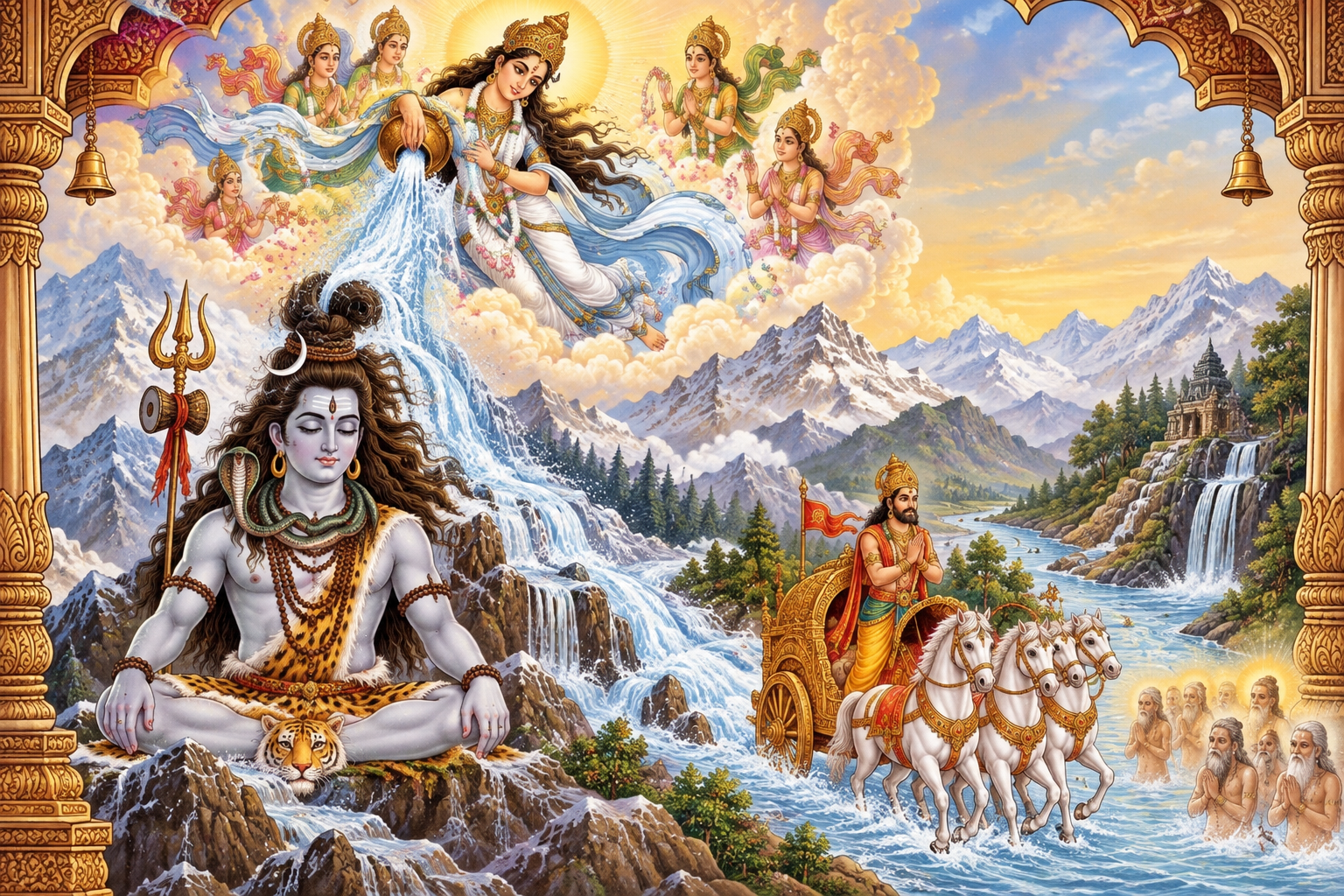
Scriptural ReferencesThe scriptural account unfolds chronologically across seven chapters, beginning in Sarga 38 with King Sagara’s grand Aśvamedha sacrifice and continuing into Sarga 39 as his sixty thousand sons unearth the earth in search of the stolen horse. Sarga 40 details Sage Kapila’s yogic wrath incinerating the arrogant princes, followed by Sarga 41, where Aṃśumān retrieves the horse and learns that only the celestial river can cleanse their remains. Sargas 42 through 44 conclude the epic cycle: Bhagīratha secures Brahmā’s boon through severe tapas, Lord Śiva traps and tames the torrent within his matted hair (jaṭā), the river is swallowed and rebirthed by Sage Jahnu, and Gaṅgā finally enters Pātāla to wash over the ancestral ashes and grant ultimate liberation (mokṣa).
Editorial NoteBeyond its theological framework, the legend of Gaṅgāvataraṇa operates as a profound ecological and cultural allegory. Lord Śiva’s matted locks mythologise the Himalayan forest canopy and high-altitude terrain, which naturally cushion torrential monsoon deluges and release them as steady, life-giving rivers rather than catastrophic floods. Concurrently, Bhagīratha’s multi-generational pursuit immortalises the ancient ethos of ancestral duty (pitṛ-ṛṇa), demonstrating that resolving inherited debts and securing spiritual liberation require disciplined, cumulative sacrifice across generations.

Dharmartha presents traditional knowledge with respect for its sources. Practices vary by lineage and region; this material does not assert exclusive or universal authority.

Related Services

Bring this into practice

Have a Shiva-related pooja, homam or yagya performed for you in the traditional way.

Your notes

Private reflections you can revisit anytime.

Sign in to take and save personal notes on this page. Sign in

Questions & Discussions

Ask a question or start a discussion about this page.

  • No questions or discussions yet — be the first.