Kathas · Puranic
Durga Saptashati (Devi Mahatmyam)
दुर्गा सप्तशती (देवी माहात्म्यम्)
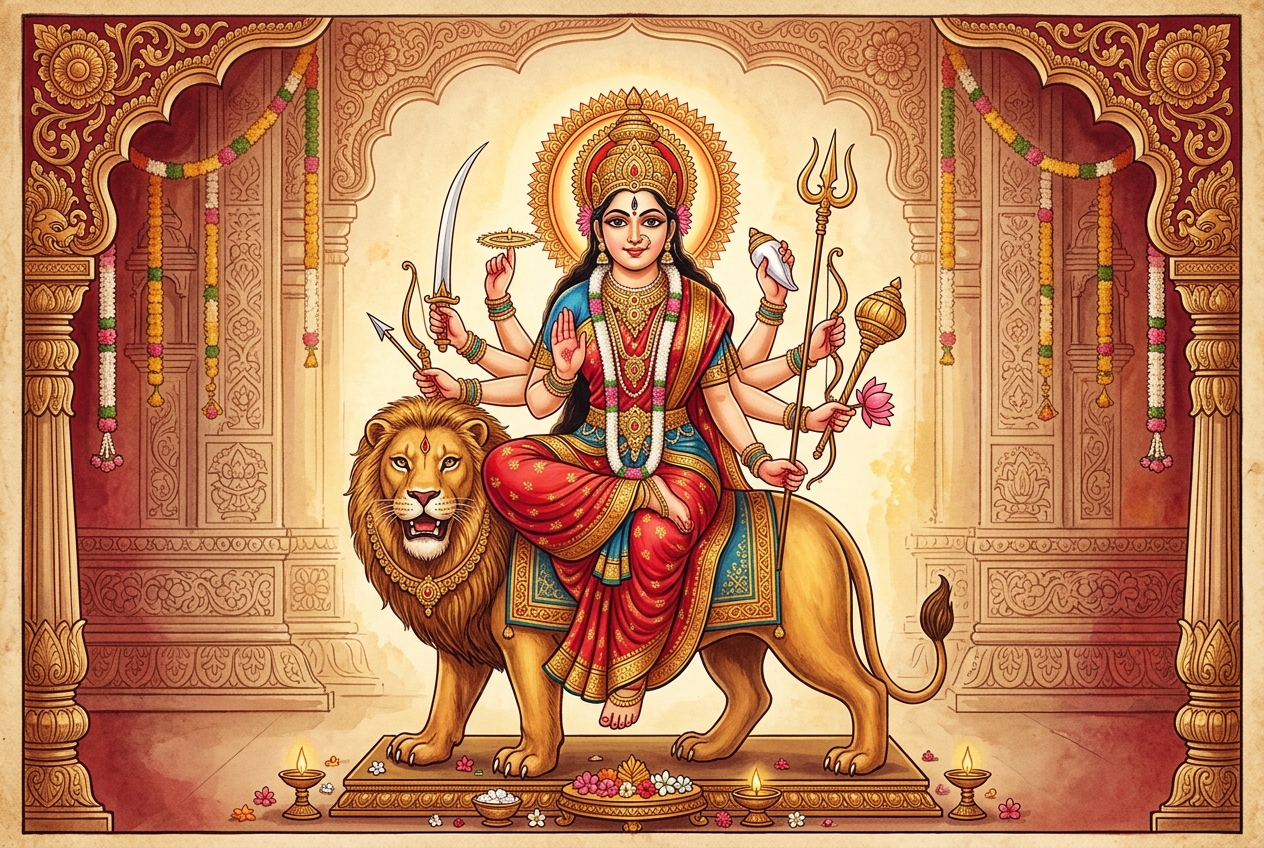
The crown jewel of Shakta literature embedded in the Markandeya Purana, comprising 700 verses across 13 chapters that celebrate the cosmic battles, forms, and supreme philosophy of the Divine Mother as Mahakali, Mahalakshmi, and Mahasaraswati.
The Devī Māhātmyam (also revered as the Durgā Saptaśatī or Caṇḍī Pāṭha) constitutes chapters 81 to 93 of the Mārkaṇḍeya Purāṇa. Framed within the narrative of King Suratha (deprived of his kingdom) and the merchant Samadhi (betrayed by his family), who meet at the hermitage of Sage Medhas, the scripture uses their existential sorrow to reveal the cosmic play of Mahāmāyā. Spanning three primary sections (Prathama, Madhyama, and Uttara Charitras), the text describes the slaying of Madhu-Kaitabha, Mahishasura, Dhumralochana, Chanda-Munda, Raktabija, and Shumbha-Nishumbha. Interwoven with these battles are four majestic philosophical hymns that establish the Mother as the material cause, operating intelligence, and ultimate non-dual ground of the cosmos.
How It Is Used
Navaratri Daily Chanting: Distributed across 9 days or read in sets: Chapter 1 on Day 1, Chapters 2–4 on Day 2, Chapters 5–6 on Day 3, Chapters 7–8 on Day 4, Chapters 9–10 on Day 5, Chapter 11 on Day 6, Chapter 12 on Day 7, and Chapter 13 on Day 8.
Chandi Homa: The entire 700 verses are recited continuously with oblations of payasam, ghee, dry fruits, and red flowers into the consecrated fire altar, ending with Svāhā for each mantra.
Inner Psychological Armor: Practitioners recite the Argala, Kilaka, and Kavacha daily as a morning protective shield against anxiety, nightmares, and negative influences.
Samputa Parayana: Individual verses (such as Sarvabadhap Prashamanam... or Roganasheshana...) are prefixed and suffixed to every chapter verse during targeted crisis resolution.
The Devī Māhātmyam represents the watershed moment in Indian religious history where the Goddess was formally canonized not as a secondary consort to male divinities, but as the supreme, unconditioned Absolute (Parabrahman Itself). While earlier Vedic literature praised feminine principles (such as Vac, Sri, and Durga/Agni), the Saptashati synthesizes them into an all-encompassing Shakta non-dual theology.
The battlefield narratives are not merely historical or mythical wars; they are profound allegories of human consciousness:
Madhu & Kaitabha: Born of ear-wax/sloth, they symbolize mental inertia (Tamas) and passionate ego (Rajas) that can only be slain when spiritual sleep (Yoga Nidra) ends.
Mahishasura: The shapeshifting buffalo demon represents brute animalistic instinct, arrogance, and shape-shifting deception that defies righteous discipline.
Raktabija: The demon whose drops of blood create duplicate demons when touching the ground represents uncontrollable desires and chain-reaction thoughts (Vrittis) in the human mind, which can only be consumed directly by the awakened, non-reactive dark void of consciousness (Kali).
Chapter 1
Adhyaya 1 · Madhu-Kaitabha Vadha
प्रथम अध्याय · मधुकैटभवध
Sources & References
Dharmartha presents traditional knowledge with respect for its sources. Practices vary by lineage and region; this material does not assert exclusive or universal authority.
Related Knowledge
Markandeya and Mahakala
The story of Sage Mārkaṇḍeya, his devotion to Lord Shiva, and his triumph over death.
Savitri and Satyavan
The story of Savitri's unwavering devotion, and the boons that ultimately restored her husband, Satyavan’s life.
Descent of Ganga
An epic chronicle of King Bhagiratha's penance that brought Ganga to the earth. The endurance of an ascetic effort so unyielding that it birthed the Hindi idiom Bhagiratha Prayas (भगीरथ प्रयास), signifying an impossible feat achieved against insurmountable odds.
Related Services
Bring this into practice
Have a Durga-related pooja, homam or yagya performed for you in the traditional way.
Your notes
Private reflections you can revisit anytime.
Questions & Discussions
Ask a question or start a discussion about this page.
- No questions or discussions yet — be the first.