ॐ
धर्मार्थDHARMARTHA

Create a free account to save & track your favourite knowledge.

Sign up

A note on Dharmartha's ongoing development:Dharmartha is currently in an active phase of content development. Our articles, references, descriptions, and other materials are being reviewed, expanded, and updated r…

Read this in
Churning of the Ocean

Kathas · Puranic

Churning of the Ocean

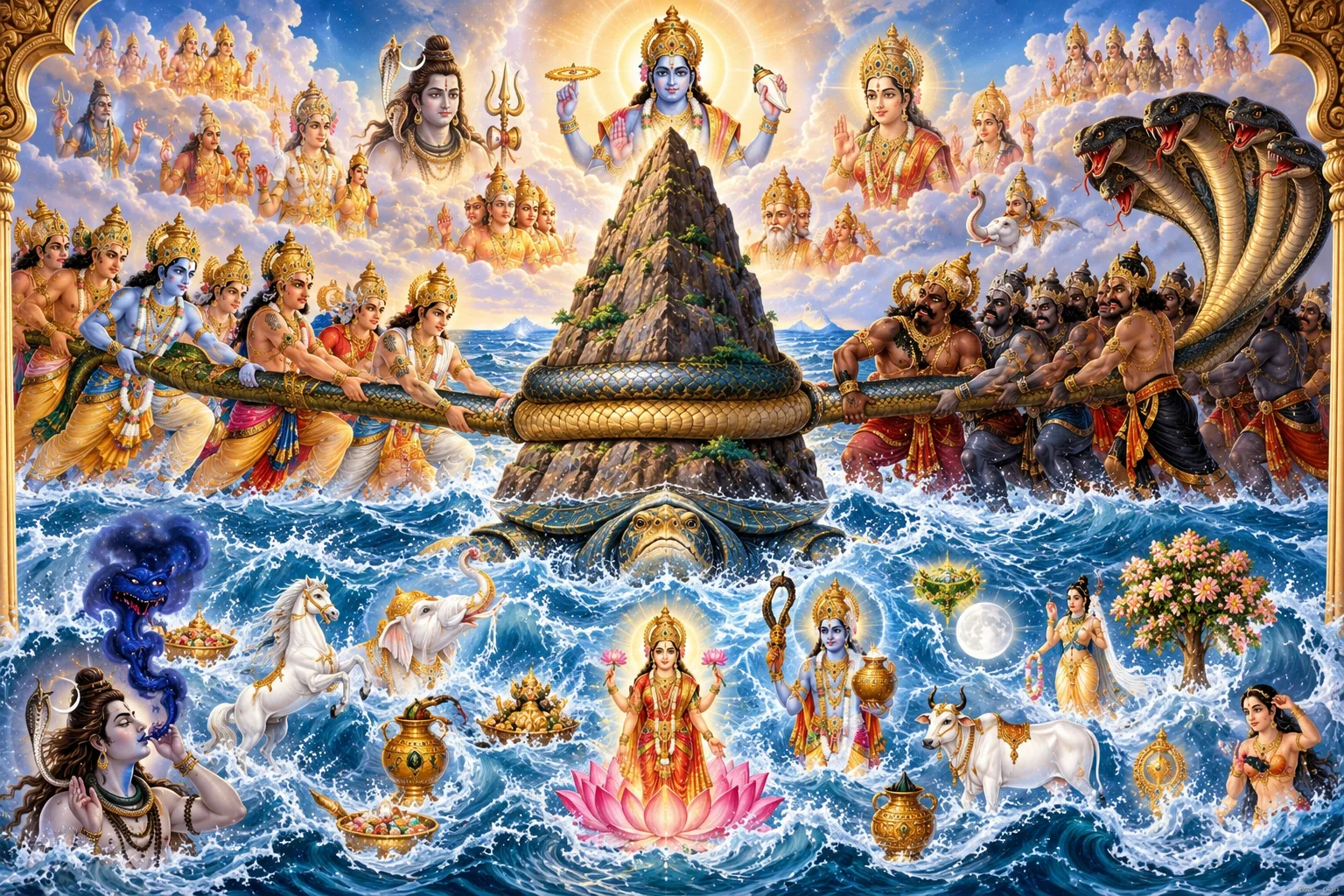
The epic of the Churning of the Cosmic Ocean by Devas and Asuras.

4 min

Chapter 1

Fall of Indra

इंद्र का पतन

Once, Lord Indra, king of the Devas, was on a royal procession across the celestial path. He was mounted on Airāvata (his magnificent white elephant) and surrounded by the host of Devas. During this journey, he crossed paths with sage Durvāsā, an incarnation or partial manifestation of Lord Śiva. The sage was known to be an immensely powerful and notoriously quick-tempered one. When they both met each other, tradition demands that the king immediately dismount, bow low, touch the sage's feet and offer words of deep reverence (praṇāma). But Indra did none of this and remained sitting on Airāvata. The sage offered a sacred garland of divine flowers gathered from the heavenly trees to Indra as a blessing. Indra should have bowed and worn it with gratitude. Instead, he casually accepted the garland and placed it on the top of Airāvata’s head. The intense fragrance from the divine flowers attracted a large swarm of bees. Irritated by the buzzing bees around his eyes, Airāvata reached up with his trunk, pulled the garland off his head, flung it down and crushed it under his feet. To sage Durvāsā, who was already famous for his explosive temper, this was an unforgivable insult. He furiously declared that Indra had become blinded by the arrogance of his power and wealth. Durvāsā explained that the garland was infused with Sri—the ultimate divine essence of fortune, prosperity and auspiciousness but Indra had treated it with disrespect. Thus, the sage cursed that Sri would abandon him and his entire kingdom. Indra and his kingdom had entered a state of Niḥśrīka—completely stripped of divine fortune. The sage explicitly decreed that just as the sacred garland had been cast down and ruined, Indra’s rule over the three worlds would be thrown to the ground and brought to ruin. The moment the curse was spoken, Goddess Lakṣmī withdrew from heaven (Svarga) and dissolved into the primordial “Ocean of Milk, the Kṣīra Sāgara”. Devas instantly withered without her presence. The divine luster faded from their skin, their magical weapons lost their edge, their minds became clouded and they lost their natural invincibility. They became weak, mortal-like and vulnerable to their enemies. Recognising the sudden weakness of the Devas, the Asuras launched a full-scale invasion led by King Bali. The Asuras overran their capital of Amarāvatī, routing the Devas and forcing them to flee heaven in exile. The Asuras seized Indra's palaces, royal treasures and dominion over the three worlds. Indra was left stripped of all his power including Airāvata.
1 / 10

Sources & References

Source / TraditionThe narrative of Samudra Manthan (Churning of the Cosmic Ocean) is a foundational narrative within the Purāṇic and Itihāsa traditions of Hindu cosmology. It is an important and widely shared narrative across the major sects of Hinduism, particularly within Vaiṣṇavism and Śaivism. The tradition uses this cosmic event to illustrate profound theological concepts: the delicate balance of universal order (Dharma), the struggle between the dualistic forces Devas and the Asuras, and the necessity of supreme divine intervention to restore balance during times of cosmic crisis.
Scriptural ReferencesŚrīmad Bhāgavatam (Bhāgavata Purāṇa) – Canto 8, Chapters 6–8: Provides the principal account of the churning, including Viṣṇu’s manifestations as Kūrma and Ajita, His support of the Devas, Asuras and Vāsuki, and the emergence of Halāhala. Viṣṇu Purāṇa – Book 1, Chapters 9–10: Provides the account of Durvāsā’s curse upon Indra, the withdrawal of Śrī, the resulting decline of the Devas, and Viṣṇu’s strategy of having the Devas cooperate with the Asuras to churn the Ocean of Milk. Mahābhārata – Ādi Parva, Astīka Parva: Contains an early account of the churning, including the participation of the Devas and Asuras, Mount Mandara, Vāsuki, and the emergence of the deadly poison.
Editorial NoteAs is common with ancient scriptural traditions spanning thousands of years, the story of Samudra Manthan exists in multiple textual and interpretive layers. Modern retellings, television adaptations and popular folklore often streamline these complex cosmic events for dramatic effect. One notable example is the conflation of Vāsuki’s venomous emissions with the universal Halāhala poison. The classical Sanskrit texts, however, distinguish between Vāsuki’s poisonous emissions during the churning and the emergence of Halāhala as a cosmic threat. Recognising the difference between popular adaptations and the classical scriptural accounts allows for a deeper and more accurate understanding.

Dharmartha presents traditional knowledge with respect for its sources. Practices vary by lineage and region; this material does not assert exclusive or universal authority.

Related Services

Bring this into practice

Have a Shiva-related pooja, homam or yagya performed for you in the traditional way.

Your notes

Private reflections you can revisit anytime.

Sign in to take and save personal notes on this page. Sign in

Questions & Discussions

Ask a question or start a discussion about this page.

  • No questions or discussions yet — be the first.

Free account

Sign in to keep reading

You've read your free entries. Create a free account to keep exploring all of Dharmartha — kathas, mantras, stotras, deities and temples — at no cost.

Back to home