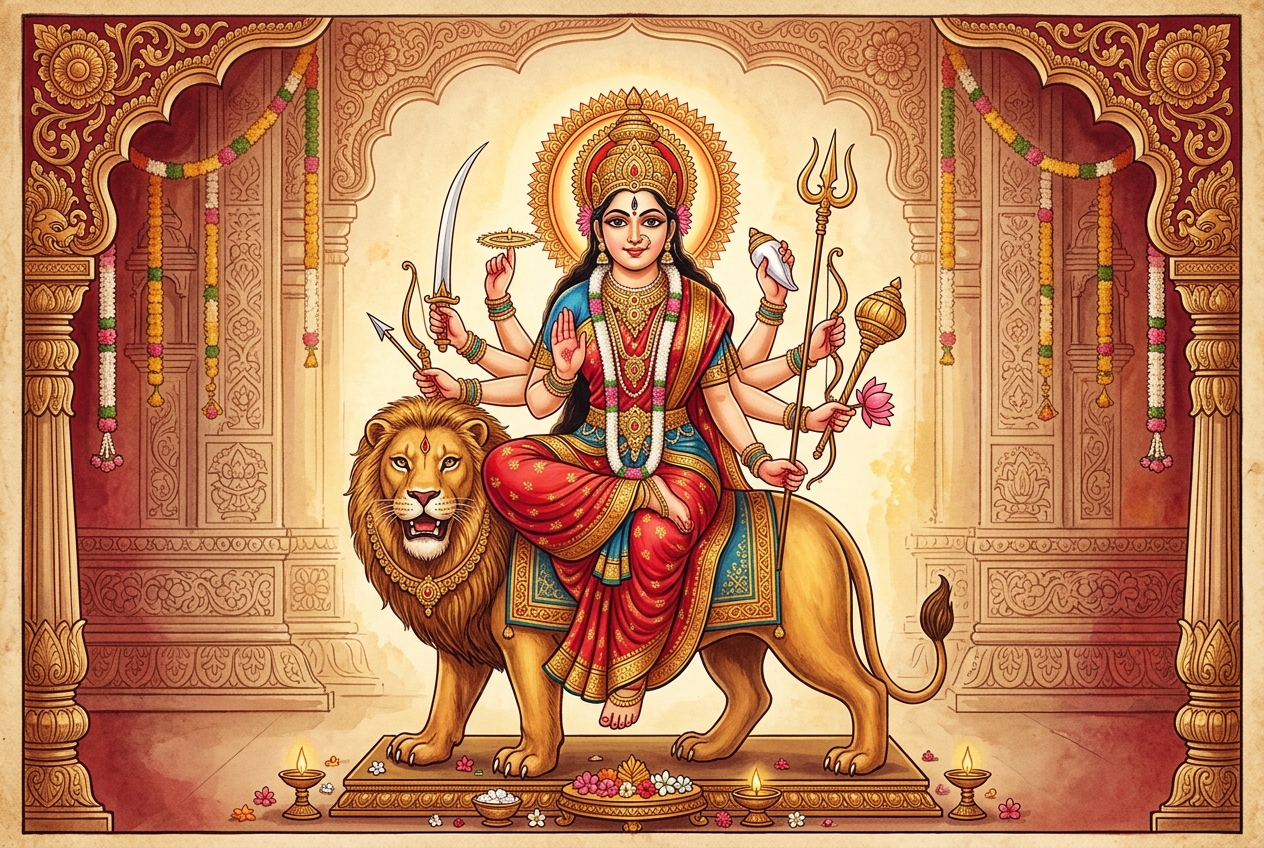
Durga Mantra
दुर्गा मंत्र
Durga Beeja-Nama Mantra
The word "Durga" literally translates to a fortress that cannot be breached. This beautiful, accessible mantra anchors the devotee to Her through Her supreme seed syllable, "Dum".
- Deity
- Durga
- Tradition
- Shakta, Universal
- Purpose
- Protection, removal of fear, peace, attainment of inner strength.
- Occasion
- Navaratri
- Source
- Śākta tradition, now universal.
मूल पाठ
Sanskrit textॐ दुं दुर्गायै नमः
Oṃ duṃ durgāyai namaḥ
Durga Mantra — recitation
अर्थ
Meaning"Om" is the primordial cosmic vehicle. "Dum" is the specific seed sound (Bija) of Goddess Durga, representing Her protective, fortress-like nature. "Durgayai" means "to Goddess Durga", and "Namaha" means "salutations". Together: "Om, I offer my salutations to Goddess Durga, the impenetrable fortress, invoked through Her seed of protection."
संदर्भ
ContextThis mantra is universally utilised across all Hindu traditions for daily protection.
प्रयोग
How it is traditionally usedChant 108 or 1008 times daily using a Red Sandalwood (Rakta Chandana) or Rudraksha mala. Sit ideally facing north for absolute protection from dangers, or facing east for inner peace and devotion to Her. It is especially powerful when chanted on Tuesdays, Fridays, or during the Ashtami (8th) tithi.
Sources & References
Dharmartha presents traditional knowledge with respect for its sources. Practices vary by lineage and region; this material does not assert exclusive or universal authority.
Spot an error or have a suggestion?
Help us keep this accurate — report a mistake or suggest content for this page.
Your notes
Private reflections you can revisit anytime.
Questions & Discussions
Ask a question or start a discussion about this page.
- No questions or discussions yet — be the first.
Related Knowledge
Durga Saptashati (Devi Mahatmyam)
दुर्गा सप्तशती (देवी माहात्म्यम्)
The crown jewel of Shakta literature embedded in the Markandeya Purana, comprising 700 verses across 13 chapters that celebrate the cosmic battles, forms, and supreme philosophy of the Divine Mother as Mahakali, Mahalakshmi, and Mahasaraswati.
Sarasvati Mantra
सरस्वती मंत्र
The supreme seed-salutation (beeja-nama) mantra of Goddess Sarasvati, chanted to invoke Her divine grace for intelligence, supreme wisdom, artistic mastery, and eloquence of speech.
Sarva Mangala Mangalye
सर्व मंगल मांगल्ये
The universal Vedic-Tantric prayer to Goddess Durga (Narayani) for auspiciousness, marital harmony, protection, and the fulfilment of all desires.
Navratri Durga Puja Vidhi
नवरात्रि दुर्गा पूजा विधि
Complete home guide for Navratri — Ghatasthapana muhurta, samagri, step-by-step Durga puja with shodashopachara, mantras, Saptashati paath, aarti and kanya pujan.
Navratri
A nine-night Hindu festival honouring the Divine Mother (Shakti) in Her various manifestations, celebrating the victory of Dharma over Adharma through fasting, worship, and the reading of classical texts like the Devi Mahatmyam.
Continue your journey