A note on Dharmartha's ongoing development:Dharmartha is currently in an active phase of content development. Our articles, references, descriptions, and other materials are being reviewed, expanded, and updated r…
Temples of Bharat
Pancha Bhoota Sthalams
पंच भूत स्थल
Five temples where Shiva is worshipped as the five great elements.
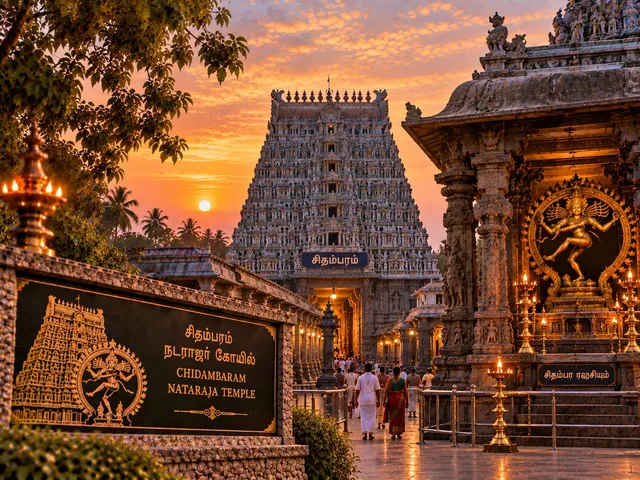
थिल्लई नटराज मंदिर
Thillai Nataraja Temple
Chidambaram, Tamil Nadu
Lord Shiva as Nataraja (Akasha Lingam / Chidambara Rahasya) and Goddess Parvati as Shivakamasundari
Thillai Nataraja Temple, situated in Chidambaram, Tamil Nadu, is one of the most celebrated and spiritually significant Dravidian temple complexes in India. Dedicated to Lord Shiva in his cosmic dance posture ( Ananda Tandava ), it is the premier shrine among the sacred Pancha Bhoota Sthalams, embodying the subtlest primordial element: Space or Ether ( Akasha ). Spread across approximately 40 acres, the temple is distinguished by its five sacred sabhas (halls)—the Chit Sabha , Kanaka Sabha , Natana Sabha , Deva Sabha , and Raja Sabha (Thousand-Pillared Hall). The sanctum’s superstructure ( Kanaka Sabha ) is crowned with a gilded roof made of 21,600 gold tiles, symbolising human breaths, fastened by 72,000 gold nails representing the vital nadis of the human body. The complex features four monumental seven-tiered Gopurams facing the cardinal directions, each elaborately carved on its granite passage walls with all 108 classical karanas (dance postures) from the Natya Shastra. Glorified extensively in the 7th-to-9th century Tevaram by the Nayanmar saints, it serves as the spiritual heart of Tamil Shaivism, where the Tirumurai texts were historically recovered.
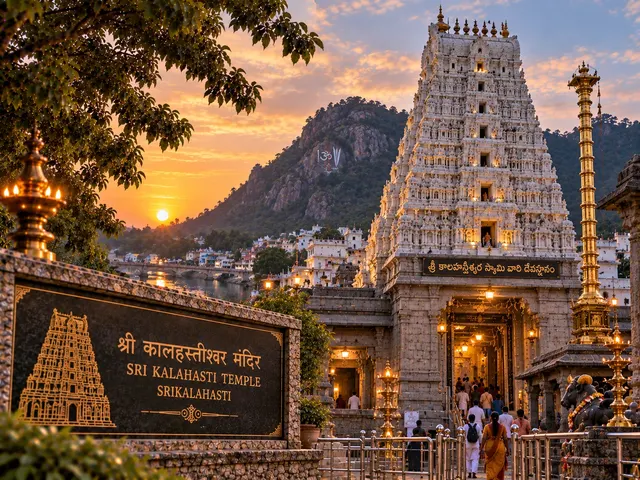
श्रीकालहस्तीश्वर मंदिर
Srikalahasteeswara Temple
Srikalahasti, Tirupati District, Andhra Pradesh
Lord Shiva as Kalahasteeswara (Vayu Lingam) and Goddess Parvati as Gnana Prasunambika Devi
Srikalahasteeswara Temple, situated on the banks of the Swarnamukhi River in Srikalahasti near Tirupati, Andhra Pradesh, is an ancient Dravidian temple complex dedicated to Lord Shiva. Revered as one of the sacred Pancha Bhoota Sthalams, it represents the element of Air (Vayu). The sanctum houses the Vayu Lingam, a self-manifested (Swayambhu) white lingam that is never touched by human hands ( Theenda Thirumeni ), even during formal worship. Nestled between the surrounding Kailasagiri and Kannappa hillocks, the sprawling temple complex features monolithic rock-cut architecture, an ornate 100-pillared hall, and towering Gopurams commissioned by the Vijayanagara ruler Krishnadevaraya in 1516 CE. A distinctive physical phenomenon confirms its representation of the wind element: even though the deep, stone-enclosed sanctum sanctorum has no windows and the oil lamps illuminating the outer shrine stay completely still, the two eternal flame lamps positioned right beside the Vayu Lingam flicker constantly. Celebrated as one of the 275 Paadal Petra Sthalams glorified by the Nayanmar saints Appar, Sambandar, Sundarar, and Manikkavasagar in the Tevaram, the temple is equally renowned across the world as the foremost Parihara Sthalam for alleviating Rahu-Ketu and Sarpa Doshas.
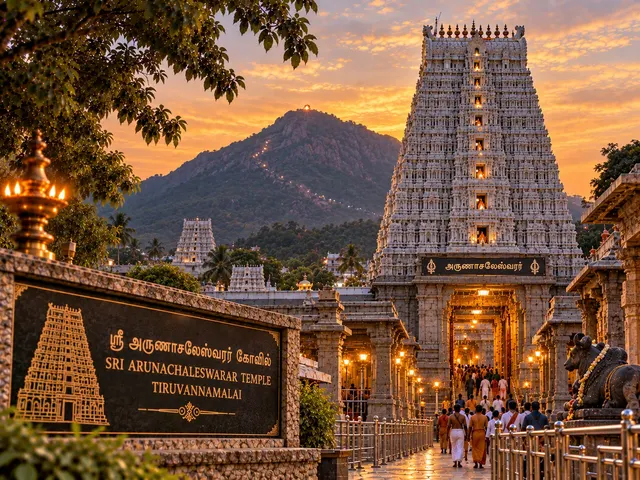
अण्णामलैयार (अरुणाचलेश्वर)
Annamalaiyar (Arunachaleswara) Temple
Tiruvannamalai, Tamil Nadu
Lord Shiva as Annamalaiyar / Arunachaleswara and Goddess Parvati as Unnamulai Amman / Apeethakuchambal
Arunachaleswarar Temple, situated at the base of the sacred Arunachala hill in Tiruvannamalai, Tamil Nadu, is one of the largest and most venerated temple complexes dedicated to Lord Shiva. Revered as one of the sacred Pancha Bhoota Sthalams, it represents the primordial element of Agni (Fire). Spanning over 25 acres with four magnificent Rajagopurams—including the massive eastern tower commissioned by the Vijayanagara monarch Krishnadevaraya—the shrine stands as a monumental masterpiece of traditional Chola and Vijayanagara temple architecture, with Agamic rituals and Shaivite worship.
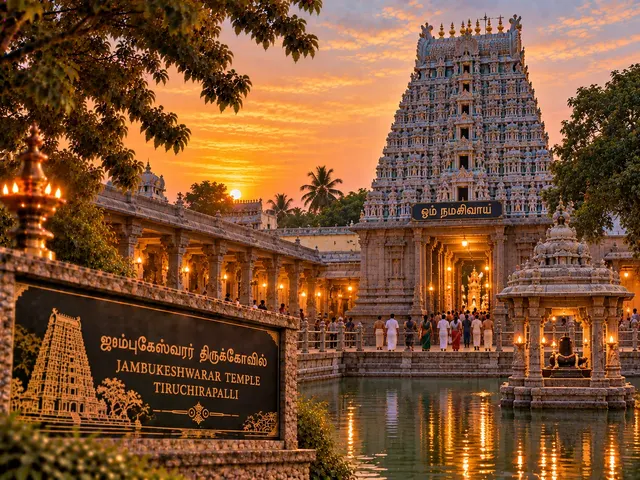
जम्बुकेश्वर मंदिर
Jambukeswarar Temple
Thiruvanaikaval, Tiruchirapalli, Tamil Nadu
Lord Shiva as Jambukeswarar (Appu Lingam) and Goddess Parvati as Akhilandeswari
Jambukeswarar Temple, situated in Thiruvanaikaval near Srirangam, Tiruchirappalli, Tamil Nadu, is rooted in Early Chola architecture and dedicated to Lord Shiva. Revered as one of the sacred Pancha Bhoota Sthalams, it represents the element of Water ( Appu ). Built around a perennial natural spring, the sanctum sanctorum remains continually filled with water, keeping the Shiva Lingam partially submerged. Spanning over 18 acres, the complex is renowned for its architectural grandeur, featuring five magnificent concentric enclosures (Prakarams) supported by intricately carved pillars and monumental Gopurams. For devotees, Thiruvanaikaval carries deep significance as one of the 275 Paadal Petra Sthalams—Shiva temples glorified in the Tevaram hymns of the Nayanmar saints—and as a temple where, according to tradition, the Goddess Herself performed penance and received spiritual instruction directly from Shiva. This is reflected in daily worship practice: the temple's noon puja, in which the chief priest traditionally dresses in feminine attire in honour of Akhilandeswari's devotion, is among its most distinctive living rituals.
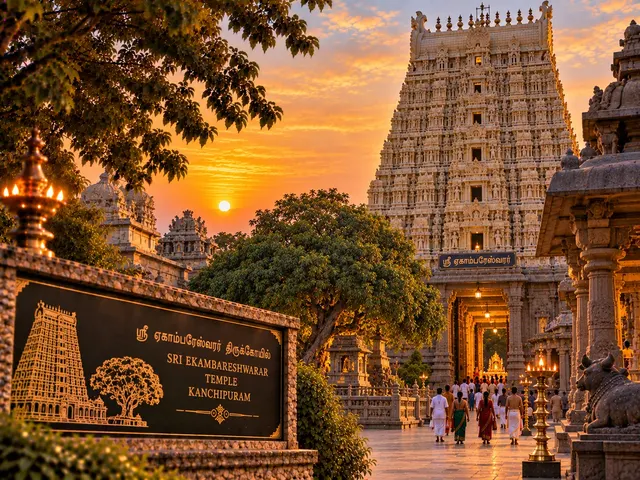
एकाम्बरेश्वर मंदिर
Ekambareswarar Temple
Kanchipuram, Tamil Nadu
Lord Shiva as Ekambareswarar / Ekambaranathar (Prithvi Lingam) and Goddess Parvati as Elavarkuzhali / Kamakshi
Ekambareswarar Temple, located in the historic temple city of Kanchipuram, Tamil Nadu, is a monumental temple complex dedicated to Lord Shiva. It was commissioned by the Pallava rulers, expanded by the Cholas and Pandyas, and brought to its grandest form by the Vijayanagara Emperor Krishnadevaraya. Revered as one of the sacred Pancha Bhoota Sthalams, it embodies the element of Earth (Prithvi). The sanctum houses the Prithvi Lingam, an earthen lingam traditionally fashioned out of sand, which receives no direct water Abhishekam to preserve its sacred form. Spanning over 23 acres, it ranks among the largest temple complexes in South India. It features four massive entrance towers (gopurams), prominent among which is the southern Raja Gopuram standing at approximately 192 feet (59 metres)—commissioned by the Vijayanagara ruler Krishnadevaraya in 1509 CE. The complex includes five sprawling concentric courtyards (Prakarams) and a magnificent Thousand-Pillared Hall. Unlike conventional Shiva temples, the complex does not have an independent inner sanctum for Goddess Parvati, as Goddess Kamakshi at the nearby Kamakshi Amman Temple is revered as the sole presiding Shakti for all Shiva shrines across Kanchipuram. Celebrated as one of the 275 Paadal Petra Sthalams, its sanctity has been extolled in the 7th-to-9th century Tevaram hymns of the Nayanmar saints Appar, Sambandar, Sundarar, and Manikkavasagar.