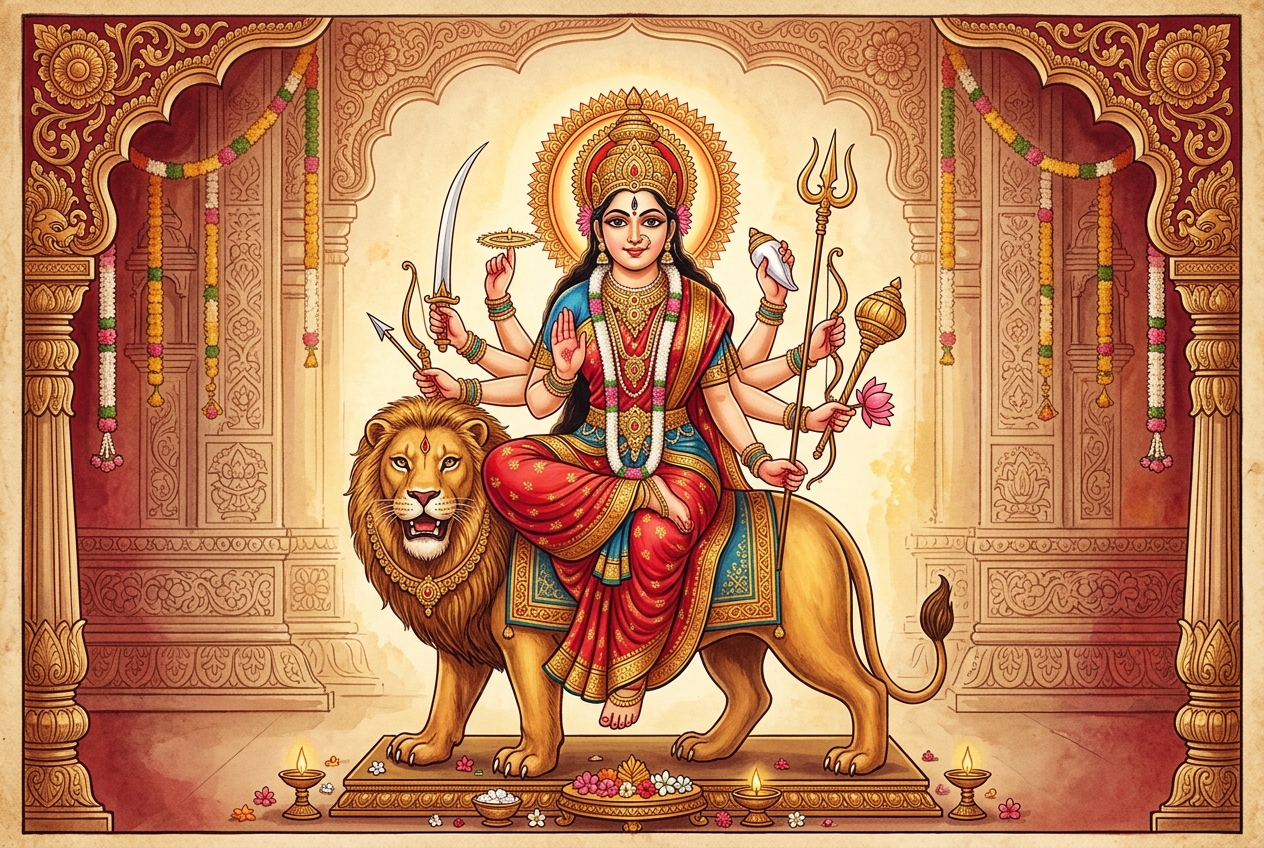
Aparajita Stuti (Tantroktam Devi Suktam)
अपराजिता स्तुति (तन्त्रोक्तं देवी सूक्तम्)
About the Aparajita Stuti (Ya Devi Sarva Bhuteshu)
Embedded in Chapter 5 of the Devi Mahatmya (Markandeya Purana), the Aparajita Stuti—commonly designated in liturgy as the Tantroktam Devi Suktam—is the impassioned prayer uttered by the displaced Devas on Mount Himalaya to invoke Goddess Durga against the demons Shumbha and Nishumbha.
- Deity
- Durga
- Tradition
- Shakta, Smarta, Universal
- Purpose
- Sarva-vighna-vinashana (annihilation of all adversities), Atma-raksha (spiritual protection), Chitta-shuddhi (purification of consciousness), Devi-kripa (attaining Her supreme grace).
- Source
- Śākta tradition, Smārta tradition, Purāṇic literature.
मूल पाठ
Sanskrit textनमो देव्यै महादेव्यै शिवायै सततं नमः। नमः प्रकृत्यै भद्रायै नियताः प्रणताः स्म ताम्
namo devyai mahādevyai śivāyai satataṃ namaḥ | namaḥ prakṛtyai bhadrāyai niyatāḥ praṇatāḥ sma tām
या देवी सर्वभूतेषु शक्तिरूपेण संस्थिता। नमस्तस्यै नमस्तस्यै नमस्तस्यै नमो नमः
yā devī sarvabhūteṣu śaktirūpeṇa saṃsthitā | namastasyai namastasyai namastasyai namo namaḥ
या देवी सर्वभूतेषु बुद्धिरूपेण संस्थिता। नमस्तस्यै नमस्तस्यै नमस्तस्यै नमो नमः
yā devī sarvabhūteṣu buddhirūpeṇa saṃsthitā | namastasyai namastasyai namastasyai namo namaḥ
या देवी सर्वभूतेषु मातृरूपेण संस्थिता। नमस्तस्यै नमस्तस्यै नमस्तस्यै नमो नमः
yā devī sarvabhūteṣu mātṛrūpeṇa saṃsthitā | namastasyai namastasyai namastasyai namo namaḥ
या देवी सर्वभूतेषु शान्तिरूपेण संस्थिता। नमस्तस्यै नमस्तस्यै नमस्तस्यै नमो नमः
yā devī sarvabhūteṣu śāntirūpeṇa saṃsthitā | namastasyai namastasyai namastasyai namo namaḥ
इन्द्रियाणामधिष्ठात्री भूतानां चाखिलेषु या। भूतेषु सततं तस्यै व्याप्तिदेव्यै नमो नमः
indriyāṇāmadhiṣṭhātrī bhūtānāṃ cākhileṣu yā | bhūteṣu satataṃ tasyai vyāptidevyai namo namaḥ
चितिरूपेण या कृत्स्नमेतद्व्याप्य स्थिता जगत्। नमस्तस्यै नमस्तस्यै नमस्तस्यै नमो नमः
citirūpeṇa yā kṛtsnametadvyāpya sthitā jagat | namastasyai namastasyai namastasyai namo namaḥ
Aparajita Stuti (Tantroktam Devi Suktam) — recitation
अर्थ
Meaning"To the Divine Mother who abides in all living beings as Consciousness, Intellect, Vital Energy, Peace, Contentment, and Maternal Protection: Salutations to Her, salutations to Her, salutations to Her, salutations again and again. To the All-Pervading Sovereign of the senses, who eternally permeates this entire cosmos as Pure Awareness: Salutations unto Her."
संदर्भ
ContextTraditionally recited as an indispensable limb of the Durga Saptashati recitation during Navaratri, this hymn is used both as an unbroken stotra recitation and as a source of individual prayoga mantras. Classical commentators establish that every single verse of this hymn possesses autonomous mantra potency capable of harmonising the psychological and pranic faculties of the practitioner.
प्रयोग
How it is traditionally usedAs a complete liturgical text, recite 1, 3, 7, 11, or 21 times daily during morning or evening sandhyas. When isolating a single seed verse for focused prayoga practice (such as chanting the Shakti-rupena, Buddhi-rupena, or Matri-rupena stanza for specific empowerment), chant 21 (minimum standard), 54 (half round), 108, or 1008 times daily using a Kamal Ghatta (dried lotus seed), Rudraksha, or Sphatik (crystal) mala. Lotus seed malas resonate with Her wealth and abundance (Lakshmi aspect); crystal malas enhance intellectual lucidity and serene absorption (Sarasvati aspect); while Rudraksha establishes energetic protection and inner fortitude (Durga aspect). Sit ideally facing north for overcoming obstacles, protection, and material nourishment, or facing east for spiritual awakening and inner stillness. Navaratri days, Shukla Ashtami, Navami, and Tuesdays or Fridays are exceptionally propitious for commencing this practice. Strict shiksha requires adhering to the metric flow of the four-line refrain (namastasyai namastasyai namastasyai namo namaḥ), keeping a clean metrical pause between each salutation without slurring the sandhi.
Sources & References
Dharmartha presents traditional knowledge with respect for its sources. Practices vary by lineage and region; this material does not assert exclusive or universal authority.
Spot an error or have a suggestion?
Help us keep this accurate — report a mistake or suggest content for this page.
Your notes
Private reflections you can revisit anytime.
Questions & Discussions
Ask a question or start a discussion about this page.
- No questions or discussions yet — be the first.
Related Knowledge
Durga Saptashati (Devi Mahatmyam)
दुर्गा सप्तशती (देवी माहात्म्यम्)
The crown jewel of Shakta literature embedded in the Markandeya Purana, comprising 700 verses across 13 chapters that celebrate the cosmic battles, forms, and supreme philosophy of the Divine Mother as Mahakali, Mahalakshmi, and Mahasaraswati.
Durga Mantra
दुर्गा मंत्र
The highly protective seed-salutation (Bija-Nama) mantra of Goddess Durga, chanted to build an impenetrable spiritual shield and overcome fear, anxiety, and danger.
Mahalakshmi Mantra
महालक्ष्मी मंत्र
The supreme seed-salutation mantra of Goddess Mahalakshmi, chanted to invoke Her divine grace for immense wealth, spiritual abundance, and lasting peace.
Sarasvati Mantra
सरस्वती मंत्र
The supreme seed-salutation (beeja-nama) mantra of Goddess Sarasvati, chanted to invoke Her divine grace for intelligence, supreme wisdom, artistic mastery, and eloquence of speech.
Sarva Mangala Mangalye
सर्व मंगल मांगल्ये
The universal Vedic-Tantric prayer to Goddess Durga (Narayani) for auspiciousness, marital harmony, protection, and the fulfilment of all desires.
Navratri Durga Puja Vidhi
नवरात्रि दुर्गा पूजा विधि
Complete home guide for Navratri — Ghatasthapana muhurta, samagri, step-by-step Durga puja with shodashopachara, mantras, Saptashati paath, aarti and kanya pujan.
Navratri
A nine-night Hindu festival honouring the Divine Mother (Shakti) in Her various manifestations, celebrating the victory of Dharma over Adharma through fasting, worship, and the reading of classical texts like the Devi Mahatmyam.
Continue your journey