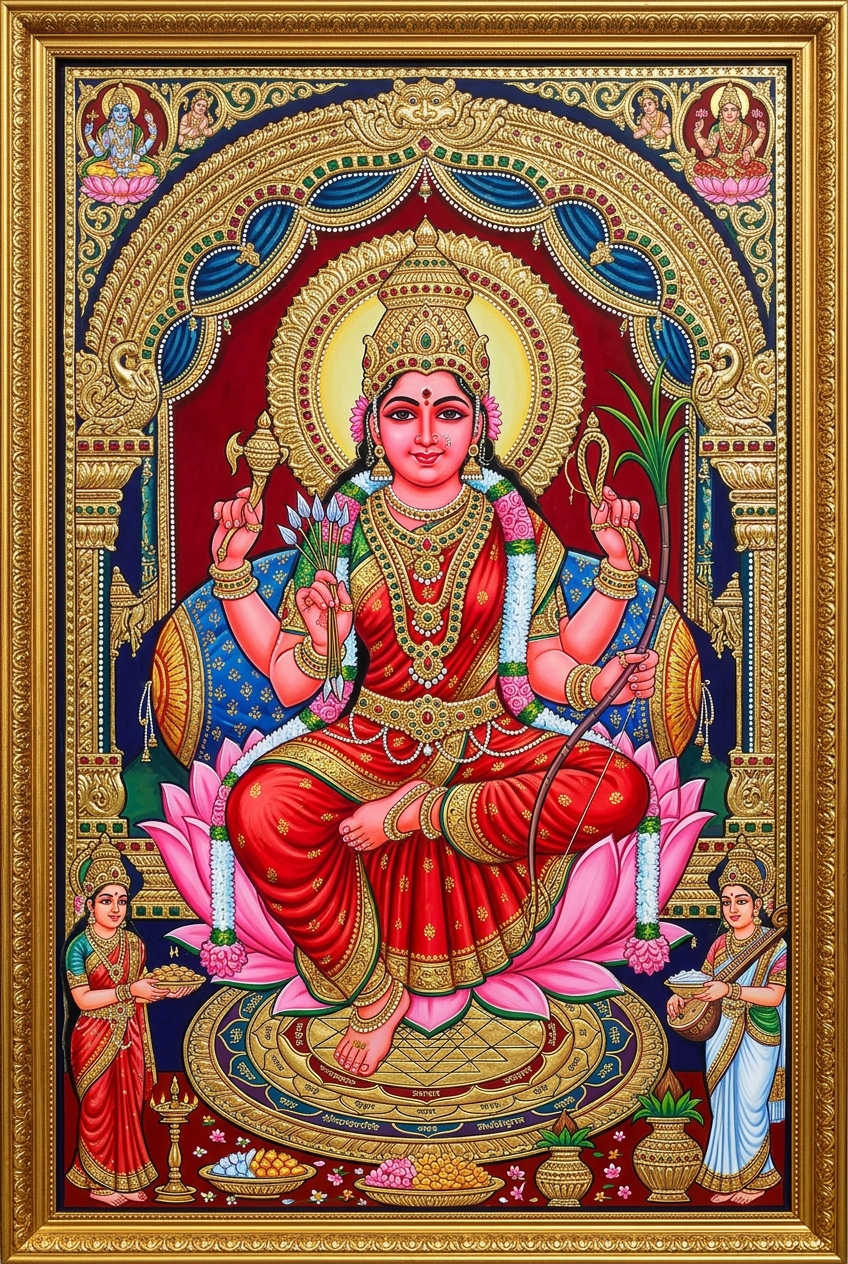
Tripura Sundari Mantra
त्रिपुर सुन्दरी मंत्र
About the Tripura Sundari Mantra
The Tripura Sundari Beeja-Nama Mantra is the auspicious, accessible gateway to the worship of Goddess Lalita Mahatripurasundari.
- Deity
- Shakti (Parvati)
- Tradition
- Shakta, Sri Vidya, Smarta, Universal
- Purpose
- Spiritual illumination, material prosperity, mental serenity, eradication of negative influences, attainment of inner harmony, liberation.
- Source
- Śākta tradition, Śrī Vidyā, Smārta, Tantra.
मूल पाठ
Sanskrit textॐ ऐं ह्रीं श्रीं त्रिपुरसुन्दर्यै नमः
Oṃ aiṃ hrīṃ śrīṃ tripurasundaryai namaḥ
Tripura Sundari Mantra — recitation
अर्थ
Meaning"Om" represents the primordial cosmic sound. "Aim" is the Vagbhava beeja of Goddess Sarasvati (wisdom and speech). "Hrim" is the Maya beeja of Goddess Bhuvaneshvari (preservation and sovereign cosmic power). "Shrim" is the Rama beeja of Goddess Mahalakshmi (spiritual and material abundance). "Tripurasundaryai" means unto Goddess Tripura Sundari, the transcendent beauty presiding over the three realms and states of consciousness. "Namah" signifies humble surrender and reverent prostration. Together: "Om, I bow with complete surrender unto Goddess Tripura Sundari, invoked through Her supreme potencies of wisdom, sovereignty, and divine abundance."
संदर्भ
ContextCodified across classical Shakta manuals such as the Mantra Mahodadhi and Sharada Tilaka Tantram, this formula serves as the primary accessible sadhana for upasakas before entering higher Tantric initiations. It is widely recited during Navaratri, on full moon nights (Purnima), and on Fridays.
प्रयोग
How it is traditionally usedChant 21 (foundational daily count), 54 (half mala), 108, or 1008 times daily using a Sphatika (clear quartz), Kamal Ghatta (lotus seed), or Rudraksha mala. Clear quartz is canonically ideal to maintain serene sattva and harmonise with Her cool lunar nature, while lotus seeds invoke auspiciousness and wealth. Sit ideally facing east for spiritual wisdom, or north for siddhi and material nourishment. Chanting during Brahma Muhurta, evening twilight (sandhya), on Fridays (Shukravara), Purnima (full moon), Shukla Panchami, and throughout the nine days of Navaratri holds peak spiritual potency. Strict shiksha requires distinct, resonant articulation of the three seed syllables (Aim, Hrim, Shrim) through the nasal cavity (anusvara) without slurring them together before intoning "Tripurasundaryai Namah".
Sources & References
Dharmartha presents traditional knowledge with respect for its sources. Practices vary by lineage and region; this material does not assert exclusive or universal authority.
Spot an error or have a suggestion?
Help us keep this accurate — report a mistake or suggest content for this page.
Your notes
Private reflections you can revisit anytime.
Questions & Discussions
Ask a question or start a discussion about this page.
- No questions or discussions yet — be the first.
Related Knowledge
Durga Saptashati (Devi Mahatmyam)
दुर्गा सप्तशती (देवी माहात्म्यम्)
The crown jewel of Shakta literature embedded in the Markandeya Purana, comprising 700 verses across 13 chapters that celebrate the cosmic battles, forms, and supreme philosophy of the Divine Mother as Mahakali, Mahalakshmi, and Mahasaraswati.
Churning of the Ocean
The epic of the Churning of the Cosmic Ocean by Devas and Asuras.
Gayatri Mantra
गायत्री मंत्र
The most revered Vedic prayer addressed to the Sun God (Savitr), chanted to illuminate the intellect and dispel ignorance.
Durga Mantra
दुर्गा मंत्र
The highly protective seed-salutation (Bija-Nama) mantra of Goddess Durga, chanted to build an impenetrable spiritual shield and overcome fear, anxiety, and danger.
Mahalakshmi Mantra
महालक्ष्मी मंत्र
The supreme seed-salutation mantra of Goddess Mahalakshmi, chanted to invoke Her divine grace for immense wealth, spiritual abundance, and lasting peace.
Sarasvati Mantra
सरस्वती मंत्र
The supreme seed-salutation (beeja-nama) mantra of Goddess Sarasvati, chanted to invoke Her divine grace for intelligence, supreme wisdom, artistic mastery, and eloquence of speech.
Sarva Mangala Mangalye
सर्व मंगल मांगल्ये
The universal Vedic-Tantric prayer to Goddess Durga (Narayani) for auspiciousness, marital harmony, protection, and the fulfilment of all desires.
Navratri Durga Puja Vidhi
नवरात्रि दुर्गा पूजा विधि
Complete home guide for Navratri — Ghatasthapana muhurta, samagri, step-by-step Durga puja with shodashopachara, mantras, Saptashati paath, aarti and kanya pujan.
Navratri
A nine-night Hindu festival honouring the Divine Mother (Shakti) in Her various manifestations, celebrating the victory of Dharma over Adharma through fasting, worship, and the reading of classical texts like the Devi Mahatmyam.
Continue your journey