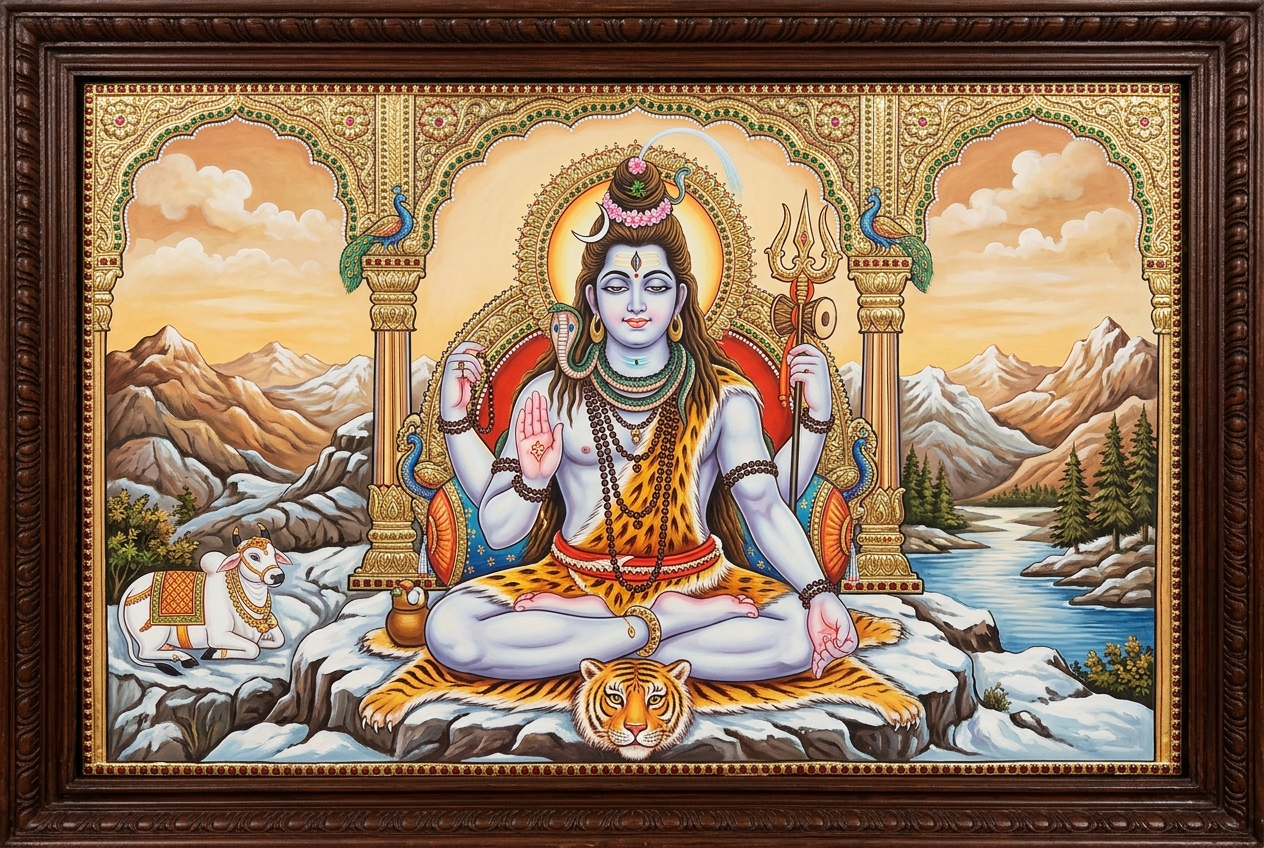
Shiva Ashtakam
शिवाष्टकम्
The Shiva Ashtakam (Tasmai Namaḥ Paramakāraṇakāraṇāya) is a revered devotional hymn dedicated to Lord Shiva, traditionally attributed to Jagadguru Adi Shankaracharya. Each verse culminates in the powerful refrain, "Brahmendra-viṣṇu-varadāya namaḥ śivāya" ("Salutations to Lord Shiva, the bestower of boons even upon Brahma, Indra, and Vishnu"). Through vivid poetic imagery, the hymn portrays Mahadeva in his dual nature—both as the fierce, ascetic yogi clad in tiger skin and ash, and as the benevolent ocean of mercy who grants liberation from worldly suffering.
- Deity
- Shiva
- Tradition
- Shaiva / Smarta (Advaita Vedanta)
- Purpose
- Dissolving worldly fears, negative karmas, and the psychological afflictions of Kaliyuga (kalikalmaṣa). Cultivating inner dispassion (vairāgya), overcoming ego and sensory desires (symbolized by Shiva's burning of Kamadeva). Attaining spiritual liberation (moksha), peace of mind, and divine grace during devotional worship (abhisheka, Pradosham, and Shivaratri).
- Source
- Shaivism / Smarta Tradition (Advaita Vedanta)
मूल पाठ
Sanskrit textतस्मै नमः परमकारणकारणाय दीप्तोज्ज्वलज्ज्वलितपिङ्गललोचनाय । नागेन्द्रहारकृतभूषणभूषणाय ब्रह्मेन्द्रविष्णुवरदाय नमः शिवाय
Tasmai namaḥ paramakāraṇakāraṇāya Dīptojjvalajjvalita-piṅgala-locanāya | Nāgendrahāra-kṛtabhūṣaṇa-bhūṣaṇāya Brahmendra-viṣṇu-varadāya namaḥ śivāya
॥ १ ॥
श्रीमत्प्रसन्नमुखपङ्कजमञ्जुलाय कन्दर्पनाशनकराय कृपामयाय । भस्माङ्गरागशुभकाय महोदयाय ब्रह्मेन्द्रविष्णुवरदाय नमः शिवाय
Śrīmat-prasanna-mukha-paṅkaja-mañjulāya Kandarp-nāśana-karāya kṛpāmayāya | Bhasmāṅgarāga-śubhakāya mahodayāya Brahmendra-viṣṇu-varadāya namaḥ śivāya
॥ २ ॥
शङ्खप्रवालमणिनूपुरसत्कराय शार्दूलचर्मवसनाय सुशीतलाय । कौपीनमात्रवसनाय मुनीन्द्रवन्द्य ब्रह्मेन्द्रविष्णुवरदाय नमः शिवाय
Śaṅkha-pravāla-maṇi-nūpura-satkarāya Śārdūlacarma-vasanāya suśītalāya | Kaupīnamātra-vasanāya munīndra-vandya Brahmendra-viṣṇu-varadāya namaḥ śivāya
॥ ३ ॥
मुण्डस्रजापरिकराय जटाधराय चन्द्रावतंसशशिशेखरमण्डिताय । गङ्गाधराय गिरिराजबृहत्सुताय ब्रह्मेन्द्रविष्णुवरदाय नमः शिवाय
Muṇḍasrajā-parikarāya jaṭādharāya Candrāvataṁsa-śaśiśekhara-maṇḍitāya | Gaṅgādharāya girirāja-bṛhat-sutāya Brahmendra-viṣṇu-varadāya namaḥ śivāya
॥ ४ ॥
मन्दारकुन्दकुसुमावलिपूजिताय कुन्देन्दुशुभ्रविभवाय दिगम्बराय । आद्यन्तशून्यविभवाय महेश्वराय ब्रह्मेन्द्रविष्णुवरदाय नमः शिवाय
Mandāra-kunda-kusumāvali-pūjitāya Kundendu-śubhra-vibhavāya digambarāya | Ādyanta-śūnya-vibhavāya maheśvarāya Brahmendra-viṣṇu-varadāya namaḥ śivāya
॥ ५ ॥
भानुप्रियाय भवनाशकराय भव्य कल्याटरूपनयनाय कलोद्भवाय । कैलासशैलनिलयाय विभूतिदाय ब्रह्मेन्द्रविष्णुवरदाय नमः शिवाय
Bhānupriyāya bhava-nāśakarāya bhavya Kalyāṭa-rūpa-nayanāya kalodbhavāya | Kailāsa-śaila-nilayāya vibhūtidāya Brahmendra-viṣṇu-varadāya namaḥ śivāya
॥ ६ ॥
यक्षोरगेश्वरसुरासुरपूजिताय कारुण्यरत्ननिलयाय कलिकल्मषघ्ने । मोक्षप्रदाय मुनिमानसराजहंस ब्रह्मेन्द्रविष्णुवरदाय नमः शिवाय
Yakṣorageśvara-surāsura-pūjitāya Kāruṇya-ratna-nilayāya kalikalmaṣaghne | Mokṣapradāya muni-mānasa-rājahaṁsa Brahmendra-viṣṇu-varadāya namaḥ śivāya
॥ ७ ॥
नित्यं पवित्रपरमामृतसागराय कारुण्यपूर्णहृदयाय त्रिलोचनाय । सर्पादिभूषणधराय सुखप्रदाय ब्रह्मेन्द्रविष्णुवरदाय नमः शिवाय
Nityaṁ pavitra-paramāmṛta-sāgarāya Kāruṇya-pūrṇa-hṛdayāya trilocanāya | Sarpādi-bhūṣaṇadharāya sukhapradāya Brahmendra-viṣṇu-varadāya namaḥ śivāya
॥ ८ ॥
फलश्रुतिः शिवाष्टकमिदं पुण्यं यः पठेच्छिवसन्निधौ । शिवलोकमवाप्नोति शिवेन सह मोदते
Phalaśrutiḥ Śivāṣṭakam-idaṁ puṇyaṁ yaḥ paṭhecchiva-sannidhau | Śivalokam-avāpnoti śivena saha modate
Shiva Ashtakam — recitation
अर्थ
MeaningVerse 1: Salutations to Lord Shiva, who is the ultimate cause of all causes, whose radiant eyes glow brightly with tawny brilliance, who is adorned with the king of serpents as a garland, and who grants boons to Brahma, Indra, and Vishnu.
Verse 2: Salutations to Lord Shiva, whose lotus-like face is graceful and beaming with bliss, who vanquished Kamadeva (the god of desire), who is full of boundless compassion, whose auspicious body is smeared with sacred ash, and who bestows boons upon Brahma, Indra, and Vishnu.
Verse 3: Salutations to Lord Shiva, whose benevolent hands are adorned with ornaments of conch, coral, and gems, who wears a tiger skin garment yet is supremely tranquil and cool, who wears only a modest ascetic cloth (kaupina), who is worshipped by the greatest sages, and who grants boons to Brahma, Indra, and Vishnu.
Verse 4: Salutations to Lord Shiva, who is surrounded by garlands of skulls, who holds matted locks, who is adorned with the crescent moon as his crown, who bears the sacred river Ganga upon his head, who is united with Parvati (the noble daughter of the king of mountains), and who grants boons to Brahma, Indra, and Vishnu.
Verse 5: Salutations to Lord Shiva, who is worshipped with bunches of Mandara and Kunda flowers, whose pure radiance shines white like jasmine and the moon, who is sky-clad (unbounded by direction), whose glory has neither beginning nor end, the Great Lord (Maheshvara), who bestows boons upon Brahma, Indra, and Vishnu.
Verse 6: Salutations to Lord Shiva, who is dear to the Sun god, who destroys the cycle of worldly birth and rebirth, whose majestic eyes gaze with auspicious grace, who is the source of all arts and cosmic creation, who resides on Mount Kailash and showers divine prosperity, and who grants boons to Brahma, Indra, and Vishnu.
Verse 7: Salutations to Lord Shiva, who is worshipped by Yakshas, kingly serpents, gods, and demons alike, who is an abode of jewels of compassion, who destroys the sins of the Kali age, who grants supreme liberation (moksha), who swims like a royal swan in the lake of the minds of meditating sages, and who grants boons to Brahma, Indra, and Vishnu.
Verse 8: Salutations to Lord Shiva, who is an eternal, holy ocean of supreme nectar, whose heart overflows with empathy, who possesses three eyes, who wears serpents as ornaments, who bestows pure happiness, and who grants boons to Brahma, Indra, and Vishnu.
Phalashruti: Whoever recites this sacred Shivāshtakam in the holy presence of Lord Shiva attains Shivaloka (the supreme abode of Shiva) and rejoices in eternal communion with Lord Shiva.
प्रयोग
How it is traditionally usedRecited during daily Shiva Puja and temple archana, particularly while offering Bilva leaves (Bilvashtakam accompaniment) or water during Jalabhisheka.
Chanted during evening Pradosham worship (Pradosha Vratam) and every Monday (Somavara Vrata) to invite mental clarity, peace, and Shiva's grace.
Performed on auspicious Shaiva observances such as Maha Shivaratri, Masa Shivaratri, and throughout the sacred month of Shravana (Sawan).
Used by sadhakas and meditators seeking to overcome sensual attachments, anxiety, and the impurities of Kaliyuga through contemplation on Shiva’s transcendental forms.
Sources & References
Dharmartha presents traditional knowledge with respect for its sources. Practices vary by lineage and region; this material does not assert exclusive or universal authority.
Spot an error or have a suggestion?
Help us keep this accurate — report a mistake or suggest content for this page.
Your notes
Private reflections you can revisit anytime.
Questions & Discussions
Ask a question or start a discussion about this page.
- No questions or discussions yet — be the first.
Related Knowledge
Descent of Ganga
An epic chronicle of King Bhagiratha's penance that brought Ganga to the earth. The endurance of an ascetic effort so unyielding that it birthed the Hindi idiom Bhagiratha Prayas (भगीरथ प्रयास), signifying an impossible feat achieved against insurmountable odds.
Markandeya and Mahakala
The story of Sage Mārkaṇḍeya, his devotion to Lord Shiva, and his triumph over death.
Churning of the Ocean
The epic of the Churning of the Cosmic Ocean by Devas and Asuras.
Lingashtakam
लिंगाष्टकम्
A traditional eight-verse hymn in praise of the Shivalinga, with meaning.
Mahashivratri
The great night of Shiva, observed with vigil, recitation and abhishekam.
Mahamrityunjaya Mantra
महा मृत्युंजय मंत्र
The great death-conquering Vedic mantra of Lord Shiva, chanted to overcome fear, promote profound healing, and grant liberation.
Om Namah Shivaya
ॐ नमः शिवाय
The great redeeming five-syllable (Panchakshari) mantra of Lord Shiva, offering purification, inner peace and spiritual awakening.
Shiva Tandava Stotram
शिव ताण्डव स्तोत्रम्
The powerful hymn to Shiva attributed to Ravana, praising his cosmic dance.
Shivalinga Abhishekam Vidhi
Understanding the traditional process and offerings used in Shiva Abhishekam.
Sri Rudram Chamakam
श्री रुद्रम् चमकम्
The Sri Rudram Chamakam is the companion Vedic litany to the Namakam from the Krishna Yajurveda, comprising eleven anuvakas of invocations (ca me — "and to me") requesting 347 distinct physical, mental, societal, and spiritual blessings.
Śrī Rudram
श्री रुद्रम् नमकम्
The Sri Rudram Namakam is the core Vedic litany from the Krishna Yajurveda, comprising eleven anuvakas of salutations (namas) that revere Lord Rudra-Shiva in his terrifying, benign, and omnipresent cosmic manifestations.
Related Services
Bring this into practice
Have a Shiva-related pooja, homam or yagya performed for you in the traditional way.
Continue your journey